
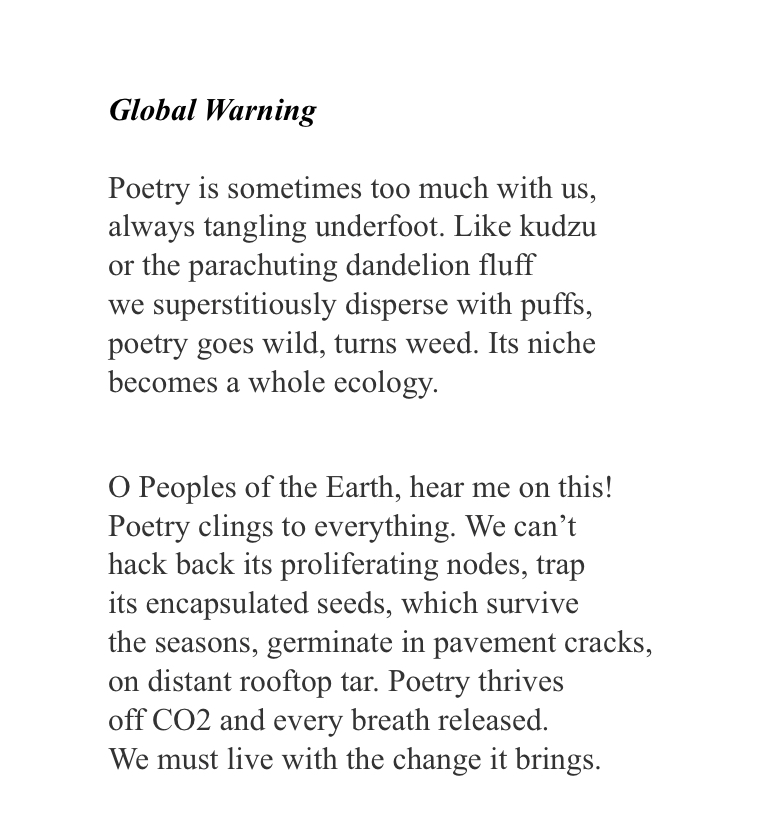
The poem Global Warning, presented in the provided document, offers a sophisticated and wry meditation on the nature of poetry itself, employing the metaphor of invasive plant species to characterize its persistent, almost uncontrollable presence in human life.
The text draws a deliberate parallel between poetry and kudzu—an aggressive, fast-growing vine notorious in the American South for overtaking landscapes—or the drifting seeds of dandelion fluff, which spread with casual human breath. The poet describes poetry as proliferating beyond its intended bounds: it “goes wild, turns weed,” transforms its “niche” into “a whole ecology,” and “clings to everything.” This imagery culminates in the mock-prophetic address, “O Peoples of the Earth, hear me on this!” followed by the assertion that poetry draws sustenance from carbon dioxide and every exhaled breath, rendering it an inescapable byproduct of human existence. The closing imperative—“We must live with the change it brings”—echoes contemporary discourse on climate change, lending the title its double meaning as both a “warning” about poetry’s ubiquity and a playful variation on “global warming.”
The accompanying prose reflection, written years later, reveals the poem’s prescience from the author’s perspective. Composed over a decade ago, at the outset of retirement with expectations of sustained, perhaps ecstatic poetic production, the work anticipated a subtler reality. Rather than dramatic, Dylan Thomas–like inspiration, poetry has manifested as a constant, simmering background process—never quite reaching a “boil”—yet impossible to eradicate or ignore. The author acknowledges becoming continually “entangled” in it, mirroring the kudzu-like persistence foretold in the verse.
The piece appears on the website alteritas.net under the section “Pastis @ Bandol,” where it is attributed to the poet George Lang. This blog serves as a platform for his original poetry, translations, and personal essays, often exploring themes of nature, memory, transience, and the craft of writing.
Overall, Global Warning functions as both an ars poetica and a gently ironic self-commentary. It portrays poetry not as a rarefied art but as an invasive, adaptive force—vital, tenacious, and ultimately inseparable from the breath of life itself. The retrospective prose underscores this insight with quiet resignation and recognition, affirming the poem’s enduring relevance.