Although its name suggests an off-brand of adult sanitary napkin, a permie is a poem whose semantics are driven by the mechanics of permutation. I wrote my first one in 1977.
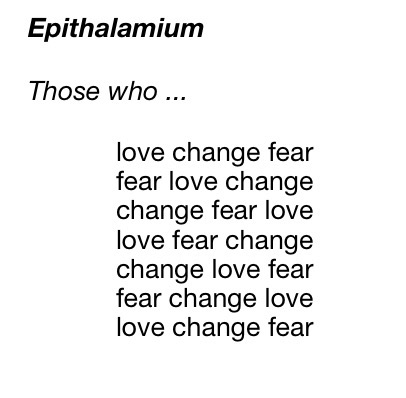
A simple matter of constructing meanings from alternative phrases provided by the poem itself.
Those who love change fear —> Those who fear love change.
The addition of an implied comma could make the readings more varied. Take the fourth line:
Those who love, fear change —> Those who love fear, change.
A world of possibilities open up.
I was alerted to permies by a recent experience with a quatrain I composed early one morning.
I dreamed I wrote a perfect line.
Morning come, it was erased.
Was it hap or by design
All that sleep time gone to waste?
Just as light began to suffuse the room it dawned on me that the order of the sentences could change into:
Was it hap or by design,
All that sleep time gone to waste?
I dreamed a wrote a perfect line.
Morning come, it was erased.
And that simple inversion of a couple of couplets was just one possible arrangement. According to the laws of possibilities, though not probabilities, 24 sets can be derived from any four discreet items. The opacity of language and the constraints of syntax keep the number of plausible permutations down from the total of possible combinations.
No doubt my discovery was due to my love for palindromes, in particular the works of Anthony Etherin (https://bsky.app/profile/anthonyetherin.bsky.social), as well as the Brazilian and other palindromistas around Liga Ágil (https://bsky.app/profile/ligaagil.bsky.social).