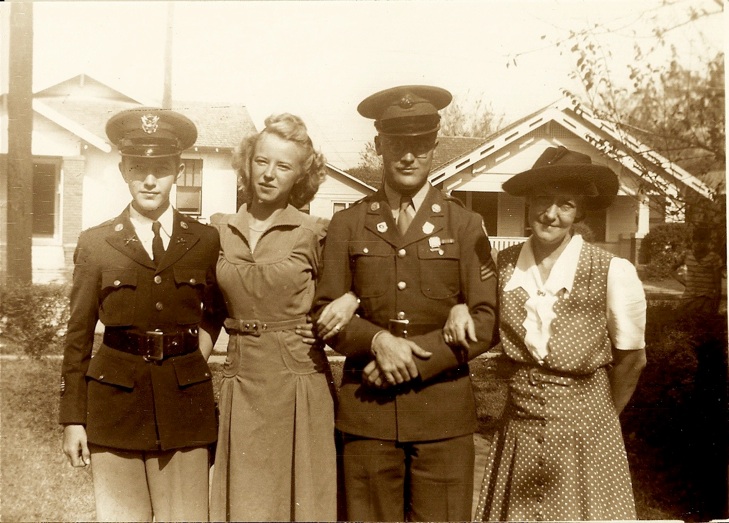
In Memoriam George Masterson Maclaine (1921-1944)
I wrote the original version of this text in Cortona, Italy, in February, 2000, the events described transpiring between August and late October, 1999. I remember being pleased to find a way to turn email into narrative. Ten years later I have revised it for this new setting. Twenty-three years later I am reposting it.
I am particularly grateful to James E. Hodges, comrade-in-arms of George Maclaine, for the information he provided, and to cousin Ann Maclaine who proved to have the trove of documents described below.
There was nothing left of Uncle George to mention, so after the requisite three hundred and sixty-six days they declared him dead. Eventually, they engraved his name on the Wall of the Missing at the military cemetery in Epinal, France. As a child I was well placed to measure the effect of his loss, since the name of this branch broken off our family tree was bequeathed me. Sometimes when his mother called me by it, I felt she didn’t know I wasn’t him.
No conspiracy of silence surrounded George, instead a circle of discretion devised to spare his mother grief. “Somewhere in the south of France,” I was told when I embarked for Europe at nineteen and asked where my eponymous uncle was buried. Military sites had low priority during my Wanderjahr. For her part, Granny was just as happy to let matters drop. Eventually, after suffering progressive debilitation and havoc of mind, she passed away, taking with her the whereabouts of George’s resting place, as far as I knew.
For decades, memory of a few stray objects held his place like bookmarks in my mind. In Granny’s bedroom, a no-man’s-land into which even grandchildren were rarely admitted, there hung a profile sketch by one of George’s soldier friends, a jaunty pipe jutting out above a caricature chin. Once, clambering on chairs in Granny’s dining room, I came across a stubby curved sword, a scimitar of sorts, which I unwisely brought off the mantle. I was sternly rebuked. Granny made it sound like the scabbard itself was dangerous. I later surmised George had sent it as a souvenir from North Africa.
One morning as I was signing on, it struck me out of nowhere, like a mortar shell, that I might track down George’s official record on the Web. I embarked on this quest with the tentative curiosity such searches entail. The Web was already a tangle of crud: you never know what you might dig up, if anything at all.
Straightway I established critical data was lacking. I needed to email my sister Nancy in Texas to see if she knew the number of George’s regiment. Here is her response:
Wed, 4 Aug 1999 09:19:03 -0500
George,
I am clueless on this one. Hope Mom knows. Marc told me Uncle George was in the “Engineers Corps,” which I learned from The English Patient meant a bomb detonation squad. I always had the notion, based on I know not what, that George was in the Pacific. Maybe I’m thinking about that old story he wrote about the kid who gave up money he’d saved for a baseball glove and sent to a needy kid in Japan, who in turn later killed him in Alaska..
The record shows I replied one hour, 25 minutes and 13 seconds later:
Wed, 4 Aug 1999 9:44:16 -0600
I’m pretty sure he died in the south of France not far from Avignon. The story I heard was he threw himself on a German grenade to save his mates. Got some medal for it.
He wrote that Alaska story at 15 on what I remember as Red Chief pencil tablet paper. Granny had a North African sword George sent home I once got in trouble for fiddling with. The way I have it figured, he was part of the Italian invasion and then marched up the Rhone.
Does Ann have email? She is the family historian, right? I suspect that this sudden interest, along with foggy memory and presbyoptia, is yet another effect of old age. When I first went to France, there had been talk by Granny about visiting his gravesite. Maybe that is where this is leading.
As things happen in cyberspace, Nancy was back on line within a few hours.
I had lunch with Mom today. She thought Marc would be a logical source, being a military buff. Also, Aunt Mary might have some stuff, or passed it on to Ann. I think I have her email.
Then suddenly Mom, whom Nancy and I had only recently convinced to get on line, jumped in.
Your uncle’s division was the 36th, mobilized from a National Guard Division. He broke his arm in the landing at Salerno, then was wounded at Cassino. The company was under the command of Mark Clark. They landed in southern France. George was killed on November 3, 1944, by a mine explosion. He was awarded the Silver Star. I don’t know where that has gone to. This is the way I remember it anyway.
Anything entered into a computer can be retrieved, they say, even if deleted, such is the nature of this sticky, absorbent medium. At some node in my laptop are other messages and drafts about George I wrote on Wednesday, 4 August, 1999, but the only other one from that sequence I can bring out of Trash to the luminous surface of my screen is sign-on protocol from a veterans’ webboard I had fallen upon late that night.
Thank you for participating in our conferencing system, George Lang. Please save this message. It contains important information, such as your login name and password!
Immediately I posted an open-ended query (“Seeking Info on George Maclaine, 36th Div.”), without hoping for much. Already at that site and others I had seen dozens of similar appeals logged in by a far-flung community to which I unsuspectingly belonged, orphans of a sort stranded on the farther shores of adulthood missing crucial genealogical links.
Miraculously, by Friday afternoon, there was mail in my box. A first note confirmed what I knew, Sgt. George M. Maclaine had resided at 4206 Walker Street, Houston, TX. He belonged — and this I wrote down on paper with pen — to Company B, 111th Engineer Combat Battalion of the 36th Infantry Division. Perhaps, this correspondent suggested, I could find someone in Company B by writing to the T-Patch Quarterly, the Division’s newsletter, still publishing after all these years.
A second email provided the address of 36th Division homepage, physically housed, I learned, in the Texas Military Museum at Camp Mabry, only a half mile from my sister’s house but actually seconds away, once I correctly entered the URL. Before my eyes slowly unscrolled a trove of text and photos and maps on WW II history, bounty some benevolent angel had meticulously transferred into cyberspace. I thought I knew George’s date of death, November 3, ironically the birthday of my brother Marc. So to see where George lay would be a simple matter, I imagined, of searching for events circa November, 1944. I followed the sequence of links from Oran through Sicily and to the disembarkation at Salerno, thence north to Rome and along the Tuscan coast up to the Gothic Line, where the German forces held, at which point the 36th was withdrawn and mustered to prepare the invasion of southern France.
The 36th had the reputation of a hard luck outfit, always in the worst places at the worst times, to wit the Rapido River south of Rome, where according to the New York Times they “suffered losses that look heavy to American military history.” The dispatch continues: “The 36th has never had an easy assignment. This writer saw one of its battalions when what was left of it clambered back across the Rapido. They were tired but remained, in essence, fresh-faced boys from Texas. Their eyes mirrored no peace.” In Across the River and into the Trees, Hemingway also alluded to the extreme casualties incurred at Rapido, but a literary figure with direct knowledge of the 36th is the poet Richard Wilbur. Or so I discovered upon the surrendipitous arrival the next morning of a book I hadn’t ordered, one sent to me, I suspect, because I had once been a book review editor. In Understanding the Literature of World War II, there is an interview with Wilbur whose poetry I deeply admire, now, especially, his reverse pastoral “Mined Country” (containing a line which has continued to haunt literary scholars: “Cows in mid-munch go splattered over the sky” — from New and Collected Poems, p. 343).
Wilbur joined the 36th after the original Texas Corps was decimated and, just discovering his vocation as poet, was doubtless out of place in the company of the rowdy recruits. “Poetry, schmoetry,” Wilbur quotes one of them saying, though he adds that he had “warm and amusing relationships with almost everyone, partly because, mostly country Texans, they were enjoyers of words — good storytellers and inventive cussers” (Understanding the Literature of World War II, p. 70). But Uncle George, from Houston, was not country, and probably not a great cusser, if Granny would have had anything to say about it.
Truth, I saw, was becoming stranger than fiction. With the serendipitous arrival of that book, Understanding the Literature of World War II, I started feeling like a character in a plot, as if I were, in the words of my wife, being called out to by events I had never conceived.
After Italy, in August, 1944, George’s Division landed on the Riviera near San Raphael. They then blitzed north through the Maritime Alps to Grenoble, where twenty years later I studied during my Wanderjahr, slightly younger than George when his Division was greeted by the Mayor and, according to photos on the 36th Division website, throngs of amorous demoiselles. I had no such luck.
Then the troops cut west to Montélimar, trapping the German command at Marseilles before moving on up the Rhone and then angling off towards Germany. The 36th was by no stretch of imagination still in the south of France. It was September. George was alive.
Over the weekend I determined that he died less than two months later in the vicinity of the town of Bruyères, west of the Vosges mountains, in northeastern France. From the beginning I had presumed he was buried somewhere, but on Saturday, the fourth night of my crusade, this landed in my inbox.
From: “WFI Research Group” <wreak1@…>
George Maclaine is listed as missing, not killed. He was declared dead in accordance with Public Law after the war. He did receive the Silver Star and two Purple Hearts. He is memorialized in the Courts of the Missing at Epinal Cemetery, France. There are records available on him. They take about 14 weeks to gather up. The fee is $45.00.
I cc’ed it to those concerned and on Sunday morning Mother replied.
I always thought the original message Granny got declared George dead. I thought the missing part was something she made up to help her accept his death gradually. We did have a visit from an army buddy who told us George and another soldier had volunteered to defuse the mines.
Then Nancy wrote, still the same day.
Now I suddenly remember being with Mom at Granny’s gravesite, noting the grave of her first husband (also a George Maclaine) and asking where her brother George was buried. Mom said then, “there wasn’t enough left of him to send home.” Which would correlate with an explosion and being “missing in action.” I guess we should have looked into this a few years ago. I’m sure there are very few witnesses left. How old would they be? At least 75.
I did talk to Ann on the phone. In June, she helped Aunt Mary pack up for the move to Galveston, and went through all the military papers. She’ll FEDEX some paper she has.
On Tuesday morning, FEDEX delivered Ann’s packet of documents, on top of which was this typsescript dated 31 Dec, 1944 — when I was a mere fingerling suspended in amniotic fluid. It read:
Sgt GEORGE M MACLAINE, 20818317, Co B, 111st Engr, was with his squad picking up ramp mines in the vicinity of Bruyères, France, on the morning of 20 Oct 44.
He and another member of the squad remained with a mine which had been removed, while the others continued on along a road. At 0815 hours, the mine exploded and both Sgt Maclaine and his comrade were instantly killed. The force of the explosion was so violent that the bodies of these two soldiers were disintegrated, and no part could be found for burial.
Mother had been wrong about the date death, to the irritation I learned of my brother Marc, who did not like his birth being confused for someone else’s death. In Ann’s FEDEX shipment there was also a clipping on the Silver Star.
It was imperative that a strategically important road be cleared of mines so that friendly tanks could support infantry elements in an attack. Sgt George M. Maclaine and three other men bravely volunteered to assist in accomplishing the hazardous mission. The stretch of road was successfully cleared of mines. When the party returned to the spot where the mines had been removed, one of them, set for delayed action, exploded, killing the four men.
There is no other record or echo of this version, which appeared in the Houston Chronicle of 11 Feb, 1945 — I was already a boy, of sorts; a tiny flange of penile tissue enclosed in my fetal self-embrace.
Everyone knew George had been blown to smithereens, but the rules required he be kept on bureaucratic life-support until 21 Oct, 1945, three months after I was born, eight months after his death was a matter of meritorious public record. War is not only hell, but an elaborate bureaucratic exercise where, as lives are lost, information accrues, more than can possibly be true.
One thought kept nagging. Landmines kill but often merely maim. Surely something must be left after the explosion of a single mine. Instead, by all accounts, George had been atomized, his soul instantaneously released to float free from the dense matrix of matter like little particles of light — just as less than nine months later I was delivered from the bright, sustaining light of the womb into the darkness of this world.
On Tuesday afternoon, less than a week into this campaign, I discovered, folding and refolding my maps of northeast France, that Bruyères was a mere two hours drive from Saarbrücken, the German border town I had been invited to speak and read my poetry in late October. I saw I would be easily able to rent a car and drive down on the Wednesday before the conference began, 20 October, 1999.
In the meantime, Mom and Marc had visited the Texas Military Museum at Camp Mabry. August in central Texas is unbearable. The air-conditioning had died, so they suffered through only the beginning of the exhibit. Mother wrote:
The part we saw was interesting, with company flags, rifles and vehicles. The medals were also on display. It’s really eerie to me but as I write this, you take on the character of my brother George and I start to say the Silver Star and the Purple Hearts are what you were awarded. I don’t think I ever told you if anyone believed in reincarnation you would fit the bill. But since I’m not sure I believe people even have souls, I’ll leave this alone.
That night a simple arithmetical fact emerged. Born on the cusp of the boomer generation, I began my sex life like all prior humans, without the luxury of chemical contraception. Human hands have ten digits, one more than necessary to count out the consequences of our lust. In those years of capricious menstruations triggered, I was convinced, by the fickle moods of the women with whom I slept, the spectre of fertility hung like a Sword of Damocles over my ambitions of travel and flight from claustrophobic Texas. So, involuntarily, out of old habit, my fingers did the counting. In the morning I wrote Mother.
As you know, I am not much of a soul person either, but last night I had not a dream, but more than a spare thought. This is an awkward question, but, as they say, I’ve done the math, and I can’t help wondering how closely my conception came to George’s death.
Four hours later, she replied.
You were expected near the end of July. You came ten days early. Love, Mom
There was thus every chance I was conceived late the evening of 19 Oct, 1944, which in mid-autumn corresponds to sunrise the next day in northern France. Say, 0815 hours, military time.
*
On October 20, 1999, I rented a car in Germany and set out for Bruyères, about two hours away. For two months an uncanny silence about George Maclaine had prevailed in my email, as if things were all said and done. Description of events in Bruyères left crucial pieces to be desired, but a sixth sense assured me I would find my way on the ground to where I had to go.
Then, just before I caught the plane to Germany, I got this letter.
Dear George,
I received my T-Patcher this week and saw the article on your wanting to know about your Uncle George. I knew him well, and have kept many records. I take the following out of the after-action report:
ON THE MORNING OF OCTOBER 20, A PARTY UNDER SGT GEORGE M MACLAINE, 20817317, WAS LEFT TO CLEAR THE MINEFIELD, BUT AS IT WAS BEING CLEARED A MINE DETONATED WHICH IN TURN EXPLODED SEVERAL OTHER MINES. THE BODIES OF SGT GEORGE M. MACLAINE AND PRIVATE JAMES E. DYER, 34360586, WERE COMPLETELY DISINTEGRATED BY THE EXPLOSION.
So there had been more than a single mine, though it remained unclear how many other bodies went up in dust. “I can tell you,” the letter continued …
… when I read this account, it was shocking to me. George was such a good guy, and a very quiet person. I have talked to one of the men who was in the same company. He told me they had taken quite a few mines up, and had them stacked in a pile. They came under heavy artillery fire, and one shell hit the pile. They never found them. There were only bits of clothing left. I am sorry to have to give you this information, but this is what happened.
If I can help in any other way….
Sincerely,
James E. Hodges, Formerly,”F” Company, 111th Engineers, 36th Inf. Division
There are thus two versions, the formal after-action report, and James Hodges’ second-hand account that mortar fire exploded the pile of mines. It doesn’t make too much difference now which is true.
Once I had the military report, though, finding where Uncle George died was a simple piece of work for someone who has been traveling and living in France since early adulthood. Small French towns seem built from the same template, easy to read once you’ve seen more than one or two. In Bruyères there is even a minor industry honouring George’s Division, considered the Liberators. There is an Avenue de la 36ème du Texas and a signposted stroll for seniors called Chemin de la Paix et de la Liberté. The Chamber of Commerce has even published a glossy album where the “Battle of Bruyères” is billed as one of the “Ten Greatest” in the history of the U.S. military according to the Pentagon itself. I bought a couple rolls of film from the photoshop and a plan of Bruyères from the local librairie. A query or two othen pointed me down the right road out of town. Exactly 0.8 kilometers east of Bruyères on the route to Belmont the road splits at a place the maps call Haut des Fourches — Height of the Forks (Google Map).
At or about 0800 hours, the sun rose over the foothills of the Vosges. The leaves, brittle in the chill breeze, had withered, not yet fallen. As long as it lasted, the pinkish dawn lent them renewed color, a semblance of life.
George and his buddy Jim had sheltered overnight, shivering against the farmhouse wall. With daylight, sniper fire resumed. Shells fell randomly along the Belmont road. Below the forks, George noticed, there was a pasture where cows munched away, oblivious to gunfire, mortar and blast. The cows glowed pink.
Already at dawn an advance party had been repulsed. Men were straggling in bunches back to the forks. George stubbed out his cigarette and scurried over in a crouch to the stack of disabled German RM-43 mines Jim was inspecting. All was in order. His time was over. Mine was about to begin.
