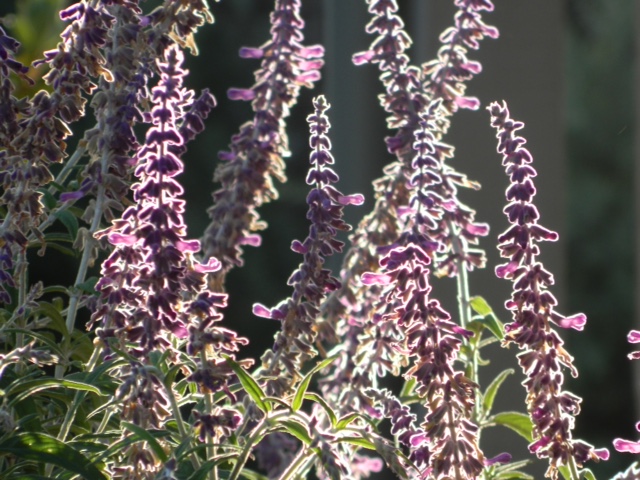
Salvia leucantha or Mexican bush sage is something of a weed around here, but a delight to hummingbirds and, seen en contre-jour, to human eyes too.

Fictions Disguised as Autobiography
Salvia leucantha or Mexican bush sage is something of a weed around here, but a delight to hummingbirds and, seen en contre-jour, to human eyes too.
As they thrash in the breeze the maples moan.
One that I know stands not quite alone
on a slope where gloom and silence cloak
a footpath running beside an ancient oak.
From its broad boughs splashes of scarlet flow
to the fresh sound of water burbling below.
An open slash in the limbs makes a frame
through which a beam pierces, igniting a flame.
The fabric of its swaying summit seems spun
from the dying fires of the crimson sun.
Among golden leaves below in a bed
there is one which flashes bright blood-red.
Twilight then mutes the luster of things, throws
ambient shadows shading to rose.
The blue-white moon heaves into sight,
spills trickles of silver into vast, pure night,
transparent splendor nothing can rival:
after setting sun, night autumnal.
***
Last week I flew into Ottawa for the first time in almost five years. It was late afternoon and the sun had slipped behind a veil of cirrus off to the west. As the little Embraer cut a slow arc east, there was a splendid view of the confluence of the Rideau River and, on the opposite shore in Québec, the Gatineau, both emptying into the Ottawa itself, once the main conduit for the canoe-driven fur trade from Montreal to the Upper Country, indeed across the entire continent. It was a week too early for most leaves to turn, but a few trees were touched with scarlet. For me, these sere tokens of memory were enough to evoke realms of blazing experience left far behind, though the season’s full radiance was yet to come.
The Canadian poet Albert Lozeau (1878-1924) lived a life too short and painful to have rivalled the great Émile Nelligan (1879-1941), who has been often likened to Arthur Rimbaud, and who bore sufferings of his own. I was delighted in 1987 when the Sherbrooke-based poetry review Ellipse asked me to translate two of his poems. The first, above, was renewing itself in my mind as the plane touched down.
The French text / On translation. Earlier version published in Ellipse 38 (1987), 113-114.