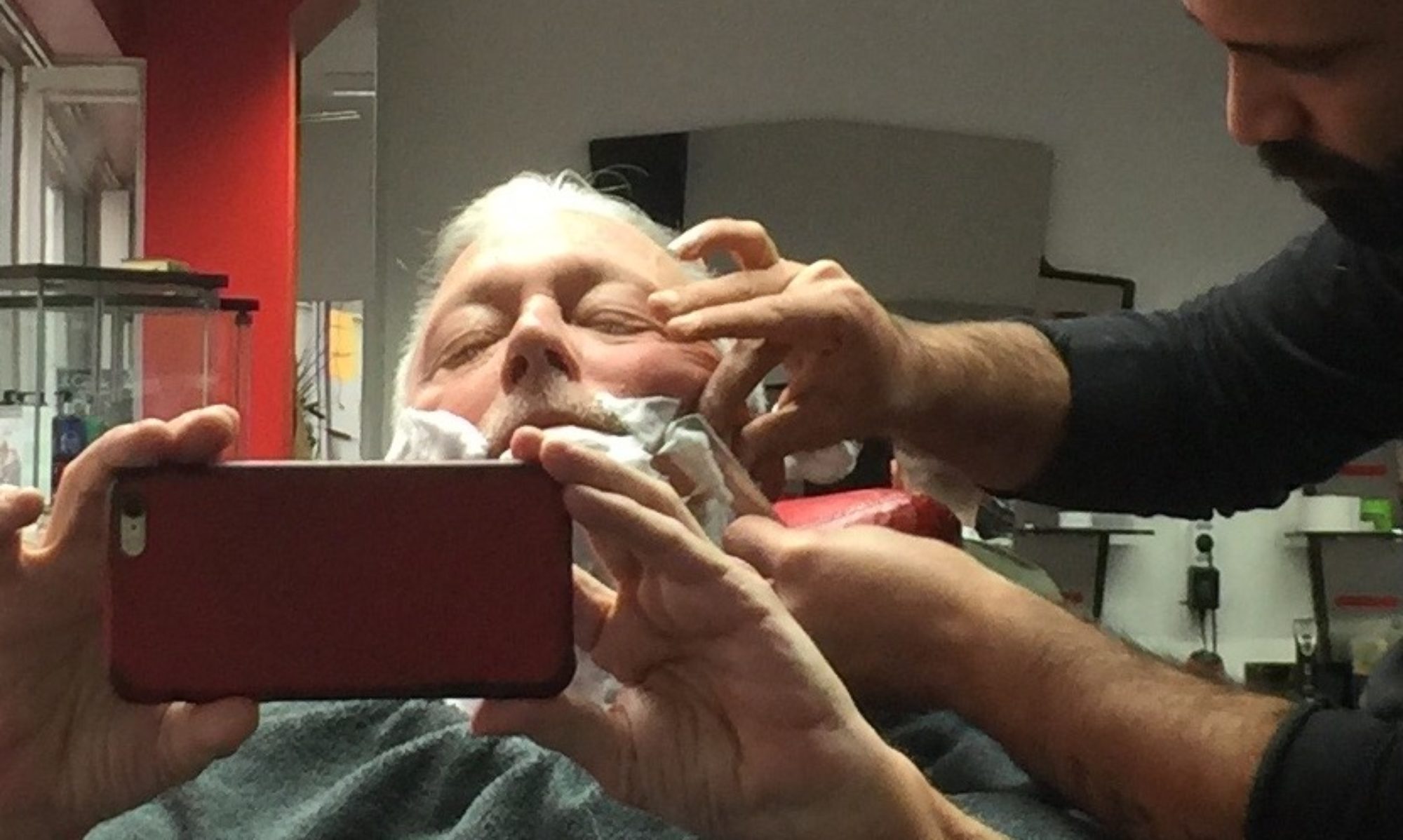
My Drunken Boat

Below the photo, my rhymed translation of Rimbaud’s Le bateau ivre. Comments follow the poem, as does a link to the original French. Without having discovered Rimbaud at 16, I probably would have taken to French and have sojourned in Africa anyway. But I was doubtless pushed along those paths by this 19th century and strictly adolescent poet, who abandoned poetry before he was 20, living out almost another two decades of travel and vagabondage, much of it in Ethiopia. 

With Rimbaud in Africa in 1968 – The Drunken Boat is in the purple edition in my left hand.

*

As I was being dragged down sluggish rivers
suddenly I felt slip the ropes of my haulers.
Whooping redskins had emptied their quivers,
nailing them naked to stakes of many colours.

I didn’t care a fig what happened to the crew
nor the cargo of Flemish wheat, English cotton.
Once the drudges had ceased their ballyhoo
I let currents bear me where I’d never gotten.

That winter, dumber than the brain of a baby,
I crossed the furious chopline of tidal spew.
Peninsulas shorn from their shores maybe
never know such triumphant tohubohu.

Storms then consecrated my transfiguration.
For days I bobbed, a lithe cork on the chaos
of swells which send many to their damnation.
Never did I miss the guiding eye of a lighthouse!

Green water soaked the timbers of my deck,
sweet as to a child the pulp of a sour apple.
Swills of blue wine and gushes of vomit broke
over me, ripping away rudder and grapple. 

At long last I bathed in the Poem of the Sea,
infused with lustrous stars like the Milky Way
glowing through aquamarine depths whence float free
pallid, pensive corpses who have seen their day.

Delirium and pulsing rhythms more intense
than alcohol, more boundless than our lyres,
beget love’s sullen, bitter rubescence
and tinge the indigo with sunset’s ruddy fires!

I knew dark skies ablaze with lightning shocks,
waterspouts, backwash, undertow. I knew twilight
and dawn exultant as doves rising in flocks.
I have seen what others thought they had in sight!

I saw plunging suns, blotched with mystic terror,
shining on strands of purple clotted clutter
and, like masked actors faced with tragic error,
distant waves closing a shivering shutter! 

And I dreamed a green night with dazzling snow,
kisses rising slowly to the eyelids of the main,
the inner coursing of unknown saps aglow,
the blue-yellow tones of a fluorescent strain!

For whole months I followed like hysterical
herds the assault of swells on coral reefs
never dreaming that Mary’s chimerical
feet could muzzle the Ocean’s wheezy puffs!

I crashed into fabulous Floridas where
flowers bore panthers’ eyes in the skins of men.
Rainbows like taut luminous bridles were
tethered to squalid flocks beneath the sea’s rim!

I saw gigantic swamps in ferment, trawls
where a whole snagged whale rotted in mushy reeds!
The precipitous collapse of waves in lulls
between storms which unleash chasms of cascades! 

Glaciers, silver suns, nacreous floods,
skies on fire, foul harbors on brown shores of doom
where giant snakes smitten with bloodsucking slugs
flop like twisted trees, venting dark perfume!

I would have loved to show a child the bream
swimming in this blue, these golden fish which sing
the foam of flowers where I sought winter’s dream,
the ineffable winds on which I took wing.

Sometimes feeling martyred, of zones and poles spent,
my lurching was calmed by the sobbing of the seas
tendered like a purfled blossom posy meant
for me to take as would a woman on her knees ….

Almost an island, my tossing deck aswarm
with pale-eyed gulls oozing slime and gossip,
I sailed on, watching the drowned in a storm
slip away and sink ass-first into deep sleep!

But, veiled by the cove’s hairy head
then cast by tempest into birdless azure,
I would never fish out those waterlogged dead.
Nor would a square-rigger or man-of-war.

Free, smoldering, from purple mist wrought,
I burst through the heavens’ reddening wall
lugging sun-bathed lichens and cerulean snot,
exquisite conserves which hold poets in thrall.

On I cruised, electric phases of the moon
lighting my mad bark, ushered by a black seahorse,
as July with its hammer blows of heat at noon
turned cyan skies into funnels of angry force. 

And I who, trembling, heard maelstroms roar and moan,
fifty leagues away, behemoth mating calls,
miner of yore of the deepest cobalt known,
I grieve now for Europe and its crumbling walls.

I saw archipelagos, atolls whose sidereal
empyrean can be glimpsed only from an isle.
“O countless golden birds, O vigorous Real,
is it in these bottomless nights you sleep in exile?”

True, I wept too much. Dawns are full of horror.
Every moon is atrocious; bitter, all suns.
Acrid love has brought but thrilling torpor.
O let my keel split! Take me where the sea runs! 

The chill murk of a puddle is all I wish
for in Europe! Under a fragrant twilight sky
a wistful child would crouch there with a flourish
to launch a boat frail as a May butterfly.  

O Seas, I can no longer abide the aims
of merchant ships, their wakes and waves,
nor suffer the pride of flags and oriflames,
nor brook the horrid gaze of galley slaves.

*

I have written elsewhere about my first encounters with Rimbaud (Not All that Beat Either). A influencial high school teacher lent me a copy of the biographical potboiler The Day on Fire, which is still in print. He ‘explicitly hoped that I would find my way to emulating Rimbaud not in his precocious poetic achievement, a rather implausible prospect, but in his scandalous relationship with the older poet Paul Verlaine’.

Soon I was parsing out the French side of the New Directions en regard edition of A Season in Hell. That translation was accompanied by the same translator’s version of The Drunken Boat. Louise Varèse, who was married to the early electronic composer Edgard Varèse, did a great job with both canonical texts. Like most translations of the latter poem, in rhymed alexandrines, hers was in free verse, which made Rimbaud come across even more modern than he was and sought to be: as he famously said:  il faut être absolument moderne.

Samuel Beckett put his version into unrhymed lines “of roughly equivalent rhythm” to the alexandrines. His version can be found at the end of this academic comparison of the French and Beckett’s English. There was a Persian translation by Mohammad-Ali Sepanloo as کشتی مست,

and also a Russian version by Vladimir Nabokov, which, we are told — those of us with scant Russian — respects both the rhyme scheme and the verse forms of the original. If so, he was truly il miglior fabbro, to cite Dante about the Provençal poet Arnaut Daniel, and T.S. Eliot about Ezra Pound. Note that both Dante and Eliot referred implicitly to making, to craft. 

So there was surely no academic need for another translation, and in this age of rampant free verse and colloquial speech acts as the basis for poetry, for sure no demand for a rhymed one. The contemporary reading public reacts to rhyme much the way I did when I was 16. How much I preferred then the prose poems of Rimbaud’s Illuminations and Season in Hell, though in retrospect I probably didn’t understand much if any of these astonishing, themselves hallucinatory works.

The slowly dawning recognition that, since assonance and consonance are integral devices in poetic language, there is no reason not to embrace or at least to work in terms of the larger patterns of sound which rhyme forms contain. 

So lately, latterly, I’ve been rhyming. See 2018: A Great Year for Translation. Two other recent rhymed translations of Rimbaud as linked after this comment.

In the present version I only on occasion resort to slant rhymes. I saw no reason to embrace alexandrines, which always feel wordy to me in English.  Rather, as if by default, I found myself using a five stress pentameter, a form which has an iambic feel even when not. This requires a certain compression, given that my translated lines are a foot shorter than Rimbaud’s. I don’t think I’ve left anything important out.

*

This translation with the French original is here

Two other Rimbaud poems in translation:
Au Cabaret vert
Sonnet du trou du cul

Other references to Rimbaud in my blogs:
Not All that Beat Either
My Black Orpheus
Frame


A Café in Vienna

I was into my third night of jet lag and needed a late supper. I wasn’t going to sleep anyway. Three minutes away was a traditional Viennese café, Eiles. Its name evokes the German word for “hurry”, which might be thought of as a translation of bistrot. That word sounds French but entered the lingo in 1921 from Russian for “rapidly”, apparently on the lips of refugees which swarmed across Europe after the Revolution.

Interior of Eiles

The implied wiki wiki aspect of bistro cafés is, however, front-loaded. Once served and sated you can wait an unseemly while to attract the waiter’s attention if you need to get up and go, a feature which used to be shared by Parisian cafés, where they have now apparently decided they don’t want you there in the first place, knowing in advance you will want the wrong food, so please pay and leave.

As the banner photo on the Eiles website shows, cafés in Vienna are bastions of upholstered comfort in which we are encouraged to linger. They are also strongholds of convention, everyone expected to conform to an implicit code of polite behaviour and set formulas of language, also to respect the traditional menu. I remember having once asked a waiter at cocktail hour, as I was enjoying a glass or two of wine with a friend, for a little dish of nuts or olives to buffer a bit the inebriation I felt rising within. Mein Herr, came the trenchant reply, “we are in Vienna in a Viennese café. If you want nuts or olives, go somewhere else.” A classic example of the Schmäh or acerbic wit for which the city is notorious.

True to form, Eiles offers standard regional fare, brothy soups in which potatoes or carrots or beets and other root vegetables play a prominent part, chives galore. Probably more salads now than back in the twentieth century, grilled and fried sausages and meats, always a schnitzel or two. And goulash. 

That Sunday night I had no fear of the digestive danger a heavy late evening meal might pose to sleep or dream. I wasn’t going to sleep anyway. So I plunked for the goulash and started with a modest Achtel, an eighth liter, of white Grüner Veltliner, actually green by name. I polished it off in a flash because I knew I would be moving on to one or more Viertels, quarter liters, of red Zweigelt. 

The goulash appeared quickly, as did the red wine, but I was in no rush. I had picked up a couple of international newspapers to browse through, a service still available in this literate setting, where free papers are bound in wooden slats and displayed on racks at strategic points. I intended to while away as much time as I could before confronting the hole of insomnia which would gape once I returned to my hotel with nothing to do but stare at the backs of my eyelids and toss and turn. Plus, cafés are inherently social spaces into which people come to watch other people, and to be watched.

Newspapers in Eiles

Austria, like most of Europe, is greying quickly. So I was firmly within the majority of senior and seniorizing citizens out on a Sunday evening for a slice of torte or similar delight and who ended up at Eiles. But we ancient ones were not alone. Viennese apartments are cozy but small and over 60% are owned by the city government which rents them to residents who earn less than 3,317 € a month, roughly $4,000. Monthly rents can easily be less than the 30% of income which financial consultants advise. That means at least some pocket change for entertainment. As in other big cities around the world, much life must pass on the street or take place in public spaces, of which a well-lit café is a perfect example, especially where winters are long and chill. So that Sunday evening there were also many not-so-grey-haired people who had met to chat quietly over coffee or cake. Some were even quite young. 

I mention all this because that Sunday night it was pleasing to the old fogey I have become to see young people so respectful of, indeed by all evidence seeking out the shelter of the local code of quiet conversation shared in the presence of others who might be browsing through a newspaper or even reading a book. It was a comforting place in which respect for others was a ground rule.

I tried nonetheless to eavesdrop on the table nearby, the four young Viennese whose demeanor and style had impressed me but also pricked something in my memory. Truth to tell, I was already a bit tight, having had about a half litre of wine by that point. That, and the fact that my German is far from accomplished, enough to get by on, read the newspapers and watch the news, enough sometimes even to make jokes, but usually lame ones. So the gist of their conversation was hard to grasp. I definitively heard passingly repeated something like “vay-gay”, though of course in German, so they weren’t talking about gender and sexuality, at least not primarily. A vay-gay is a WG, a Wohngemeinschaft, what the dictionary calls a commune, though the word has different connotations in English. 

Living in a WG is a standard rite of passage for many young Austrians. As best as I could tell this group was lamenting the sudden departure of a prospective WG roommate who had upped and decided to go back to Paris to finish a course he had abandoned. He hadn’t left the others in the lurch, having left rent for two months. But there was considerable speculation about his motives, mostly turning around matters having nothing to do with studies, inevitably affairs of the heart and/or its nether attachments.

View out of Eiles, 22h. Booth soon to be filled.

I had the odd feeling they were talking about me, though they couldn’t have been. Then it dawned on me. My personal history with Vienna goes back a long way, to Christmas of 1972. That year I was based in Paris but had tired of being there. Through a friend of a friend I was invited to Vienna where the sister of the second friend was willing to put me up for the holidays. I was excited by the prospective change of setting and had seen a photo of the sister in question, Bettina, who had a decidedly erotic appeal to my overheated twenty-six year old imagination. Why not? I had enough money to take the train, a full twenty-four hour trip in those days, and the freedom to move to and stay in Vienna if things worked out. 

That was my first encounter with the ethos of a WG. The roomates agreed that I could stay on a spare sofa in the shared living room of Bettina’s for a week if I contributed expenses to the common kitty. The question, I gathered upon my arrival, was left open whether I would move into Bettina’s own private room.  

I never did. Instead, ten days later I got back on a train for Paris, intending to collect my things and take what money I had out of the bank and return to Vienna. In those days there are no easy way for an impoverished student to transfer money from Paris to Vienna. Yet maybe I had left the account open in Paris to hold myself hostage, to make sure I’d come back. 

I was entranced with the gritty, culturally rich Vienna of 1972. Yet I remember clearly the moment I came out of the métro at Odéon, right in the center of the Left Bank. I looked around at the bustling scene and instantly decided to stay in Paris, where I lived out the year as planned. It was a hard letter to write back to Bettina, with whom I imagined I had unfunished business, as well as the other friends I had made in the WG.

Below is the link to a short story I wrote in my klutzy German a few years back, Schlafsofa, a fictionalized version. There is probably more truth in it and its translation Spare Couch than in this account of what actually happened. In both the real and the fictional versions, I gave up the chance to live in Vienna, a city I have since repeatedly visited but have only friends, no lived roots in, only memories.

That Sunday evening in Eiles thus ended in soppy nostalgia. The ensuing hours of fitful wakefulness were full of bittersweet contemplation of what might have happened almost a half century ago.  Could have, would have, should have are often the cryptic topics of jet lag, which is always about being where you aren’t.

Spare Couch /  Schlafsofa