Not unlike Provence, this sheen off a sea,
wakes jagged furrows ferries gouge into
a warped metal sheet whose irridescence
showers blind spots among protein floaters,
so radiant the glare. Or the graveyard
at Aşiyan Asri, a real Père Lachaise,
its luminaires, among them poets
I shall never read, mouldering under slabs
whose script needs parsing to comprehend.
Here at Bešiktaš my gaze falls upon
the gauzy film this raki, arak, ouzo sloughs off
spilling over crisp facets of ice,
billowing veils within a cylinder,
in whose cloud can be divined
not diaphanous future but past murk.
Suppose raki had flowed before pastis,
my Bosphorus before my original Seine,
would I now be aboe to decrypt those tumbling
graven stones, recite those poems?
Would the lives and deaths here
laid bare before me, their hard facts inscribed
as well in minaret, peristyle, dome,
be more transparent? But the world of thyme,
garlic, fig, aubergine, I found it first
the way it was, not how it came to be.
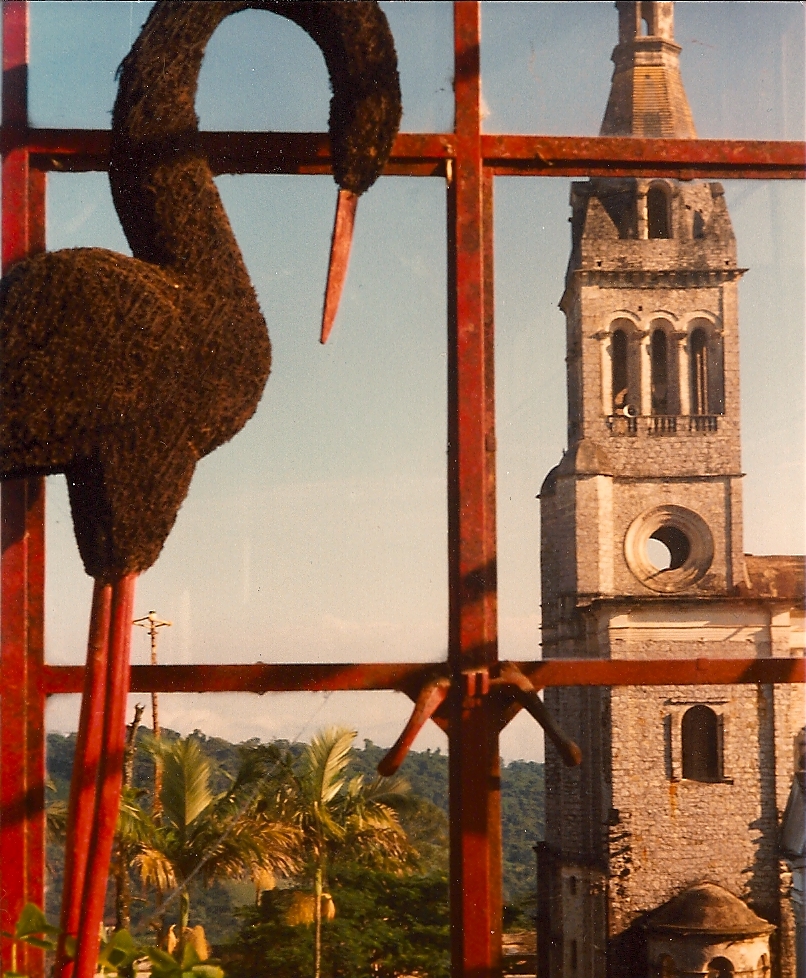
The Cathedral at Cuetzalan del Progresso, Puebla, Mexico
Friends in Laguna Beach who are lucky enough to have a wild avocado tree growing above their modest terrace right near the beach casually passed on a specimen of the perfectly ripe fruit which fall down upon them. I could try to describe the sensations of tasting it, but this choice of words already tells you I am talking about more than mere flavours. Let me put it this way: its impact was immediately destructive of time and place.
Now that is what I call food.
I was beamed not necessarily up but at least back thirty years to when I used to hang out with my friend Richard in the cloud forest of the Sierra del Norte in an old colonial town since become very touristy, Cuetzalan del Progresso. We ate so many avocados that I forgot their ubiquitous presence in our diet.
It turns out that the Mexican group of avocados evolved in the “relatively cool subtropical highlands” there (per Harold McGee). This perhaps explains why they are so happy in Laguna Beach, which, California Dreamin’ aside, is submerged most of the time under the chill of the Pacific marine layer.
A few posts back I put up the image of an avocado carved for the Day of the Dead like a miniature jack-o-lantern. It was a poor little pebbly-skinned Hass avocado, which stems from the Guatamalan family and is the sub-species chosen by the food industry for sacrifice on the altar of super-marketing. Dressed with sufficient garlic and spices, they do have some taste.
But what I had for dinner tonight was something of a different order, though roughly the same species. One bite and the above image flashed before my ears, the view over the zócalo in front of the cathedral in Cuetzalan from the little posado where I would transition during my visits.
For the record, avocado comes from the Nahuatl ahuacatl, which means testicle.
No: I am not going to concoct a recipe for a fricassé of mountain oysters in chipotle avocado sauce. This would be beyond the bounds even of glossy Bon Appétit food porn.
One raw real living avocado with a scattering of pepper, salt and chopped onion plus a sprinkling of freshly-squeezed lime was enough to produce tele-transportation.