Das Weinviertel

Reposting this old blog, which has become ever more meaningful to me as pandemic travel restrictions and the impediments of impending old age make it less and less likely that I’ll get back to Austria as much as I would like.

*
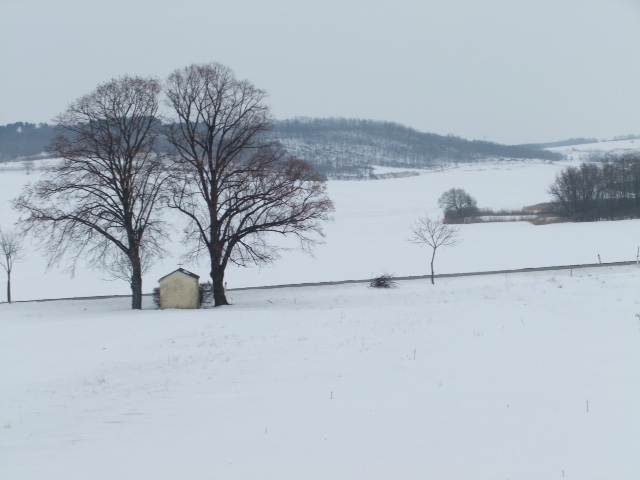
Das Weinviertel – near Mistelbach, Austria

15 February, 2010

Up near the Czech border no more than an hour from Vienna lies the homeland of Grüner Veltliner, the simple but scrumptious Austrian white you can rely on in almost any bar in the country.

I unknowingly discovered Veltliner in 1973, when long-lost Viennese friends took me out to a Heuriger for a memorable long day’s excursion into night, the details of which I can no longer remember, probably couldn’t even the next morning, except I know that the wine was delicious and flowed without restraint

There is a whole piece to write on what friendship means in Austrian German. This is just the part of it which has to do with wine.

For those who interested in the wider question, what role friendship (here male but there is a female counterpart) plays in Austrian culture, one place to begin would be Thomas Bernhard’s Wittgenstein’s Nephew: A Friendship, among my favourite books, though I hesitate to recommend it to anyone who reads for pleasure.

We could take Bernhard’s “fiction” as the story of the relationship — “Friendship” in the title is both perfectly accurate and scathingly ironic — between two eccentrics, a universal tale which belongs to humanity, and to inhumanity as well. This would be to divest both men of what Thomas Bernhard himself spends much energy denouncing, the sometimes grotesque Austrian garb of their neurotic lives.

The alert reader will immediately grasp where this thought leads, since if friendship is not a universal which humans experience more or less in the same way, than many other presumably noble human ideals are not as well, for example love, already fraught enough when lines of communication are not scrambled by language and different cultural expectations, or hate, or altruism, or bravery, or the difference between bravery and bravado, whatever their equivalents might be in given languages, if those translations can even be found.

I come around to the notion of bravado because of the chain of circumstances which looped me from drinking Veltliner in 1973 back to drinking it in 2010, in the latter case with a shock of recognition but in the former, now it almost seems, with a strange prescience across time and space.

That I found myself back in Austria in 2010 with glass of Veltliner in hand was due to a pivotal incident I can single out, the flippant challenge thrown out at the end of a boozy dinner in May, 2002, that I return to Innsbruck to ski the next winter –”if I had the nerve.”

It was like a hot button. The Texas macho side of my self, which I have for years striven mightily to rein in, suddenly succumbed to inviting echoes, sirens I could hear reverberating up across the stunning slopes of the Alps above Innsbruck, though that was late at night under moonlight and not, as in this photo, on a glorious  afternoon of Foehn.

Seegrube above the rooftops of Conradstraße, Innsbruck (18.02.2010). Telling contrast between the kitschy façades and the untramelled, fractal facets of the slopes above.  


I had never been a skier, except on water. There is not a lot of snow in Texas and during the year I spent in Grenoble, 1966, I was chronically without the financial ressources to learn. Those among the foreign students I knew then who could afford to ski were scions of Vietnamese bankers who enjoyed reminding me that in just another year or two I would be drafted off to defend their freedoms in South-East Asia, while they could continue to ski in the Alps, studying law or business or whatever on the side, their checks flowing without interruption from Geneva, their ski passes annual.

All it took in 2002 was the barest hint of a dare from my new Austrian acquaintances, Fritz and Bernhard, for me to detect and lock into a routine familiar from the hazing of adolescent rites of passage in Texas. I recognized a behaviorial language I could speak,  the terms of which are bravado, at least the posture of such, one-upsmanship, substance abuse, but also a surge of comradery I had not felt for decades, peels of laughter and shared mockery of self and others, bullshit mixed with the Absurd, surrealism and tall tales (Scheißereden), palliative but disposible philosophies of life I had forgotten the use of, intimate bastions of reprieve from self-righteousness, Selbstgerechtigkeit, the ineradicable vice of right-thinking Texans and proper Austrians, people who seriously need help and will not get it.

Alcohol is a toxin, as professional busybodies remind us everytime they have a chance, as if anyone with a smattering of self-consciousness were not fully aware of this, and from an early age.

Among the alternative agents of alcoholic intoxication, wine offers the most compensatory blessings. Its panoply of tastes and odors connect in mysterious ways with olfactory, gustatory and pheromonal agents sourced from the gamut of plants and flesh we savages consume.

What the puritans do not want us to understand and then say aloud is that the dislocation of experiences and values alcohol wreaks is also sacred in impact, wine and the gods having been linked from ancient times.

Alcohol etches into memory simulacra of the sacramental and nepenthic gestures humans seek in their most vaulted religious and communal rituals, but this potion is readily available on a daily basis, and in portable containers. Though we seek out and pay for alcohol, we do so gratuitously, for no good reason, not because a doctor says it is good for us, as we do compulsively, addictively with the copious output of the pharmaceutical industry, but because we just don’t care about what makes sense nor what might be the right thing to do.

Wine has, in addition, a special – I hesitate to use the word – psychedelic function, rendering up perception of aspects of one’s mind previously unknown.

Proust’s cup-cake would be a rudimentary metaphor for what happens when a slurp of wine courses across the tongue and sloshes along the palate, at least for the wine lush who is used to detecting entrancing traces of memory locked into vinous molecules, who has learned to decrypt the kaleidoscope of sensations triggered by thousands, no, millions of prior taste experiences scattered across a lifetime and now suspended in a fragile but vital web of pulsing associations in a colloidal medium neuroscience still knows basically nothing about, despite its pretentious soup of acronyms.

This I do know: our forebrain or left brain or whatever soggy lobe of it is charged with repression actively works to suppress the flow of imaginative energy along these ecstatically ramifying synaptic meshes. Then the wine comes along, blasting away the log-jam of repressed memories with explosive packets of savour, merciful manna which lifts us from the drudgery of our own petty, goal-oriented rationality.

My friend Bernhard, the same who pointed up at the slopes of Seegrube in May, 2002, recently bought an abandoned wine cellar in The Wine Quarter in Lower Austria (das Weinviertel). He took me there on a day trip up near the village of Mistelbach (Mistletoe Brook). The cellar is a monument to a way of life rather than a working site, though a great place to store wine, even in the depths of winter.

Behind me you can see wines covered with a foot or more of snow.

Bernhard kept talking about coming up in the summer, pitching a tent, hanging out and guzzling Veltliner, grilling sausage on an open fire. He didn’t mention swatting mosquitos or shitting in the bushes. I am not sure that the true taste of Veltliner is not best to be enjoyed in winter, when the roots themselves sleep peacefully under the warm blanket of snow, preparing the next year’s vintage, secretly imbibing minerals from the soil without the brazen interference of the sun – all that dreadful, bright green and distractingly busy photosynthesis summer brings.

Bernhard with a bottle of Tuscan red retrieved from the cellar, and the keys to his kingdom
A Café in Vienna

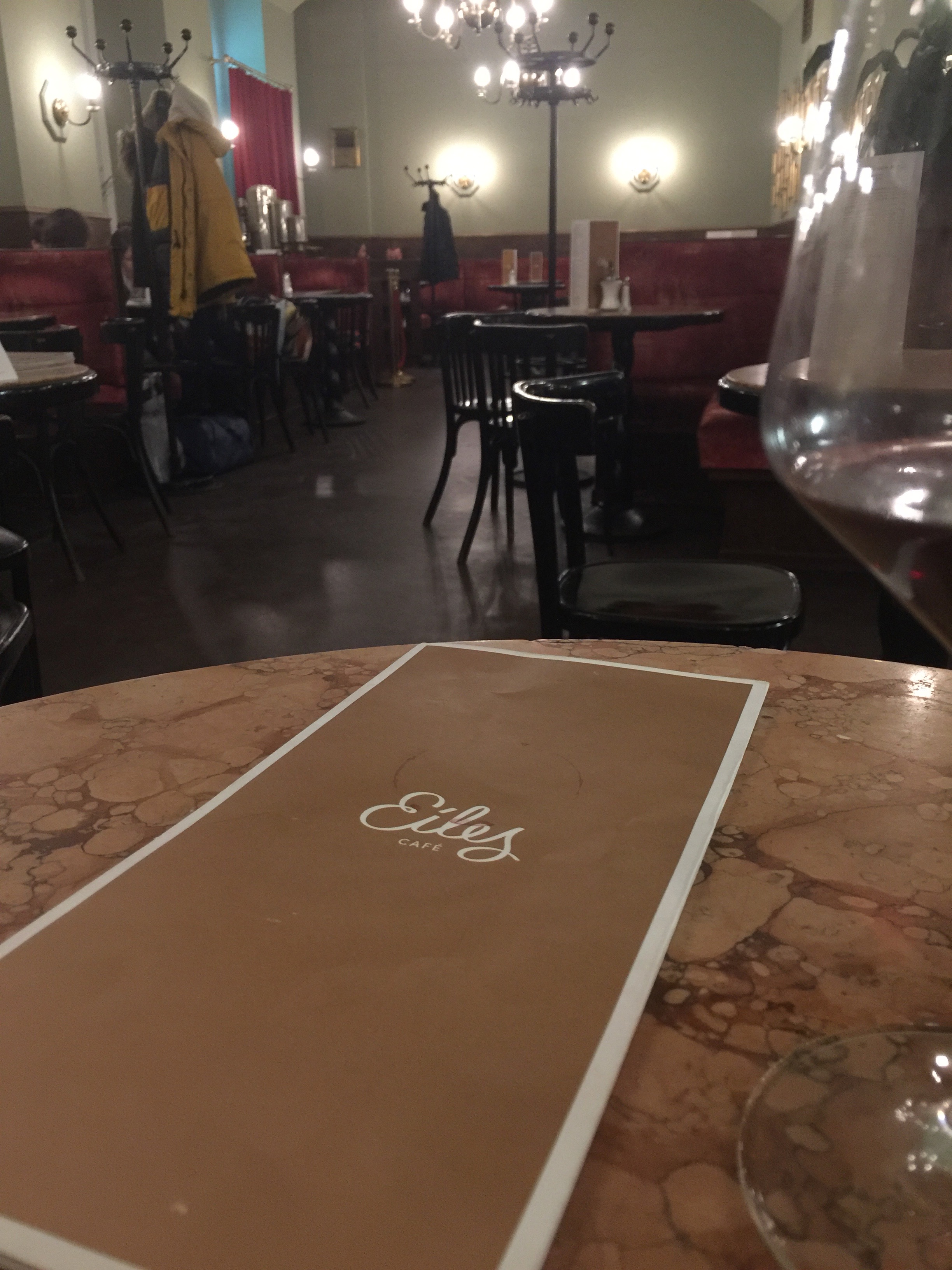
I was into my third night of jet lag and needed a late supper. I wasn’t going to sleep anyway. Three minutes away was a traditional Viennese café, Eiles. Its name evokes the German word for “hurry”, which might be thought of as a translation of bistrot. That word sounds French but entered the lingo in 1921 from Russian for “rapidly”, apparently on the lips of refugees which swarmed across Europe after the Revolution.

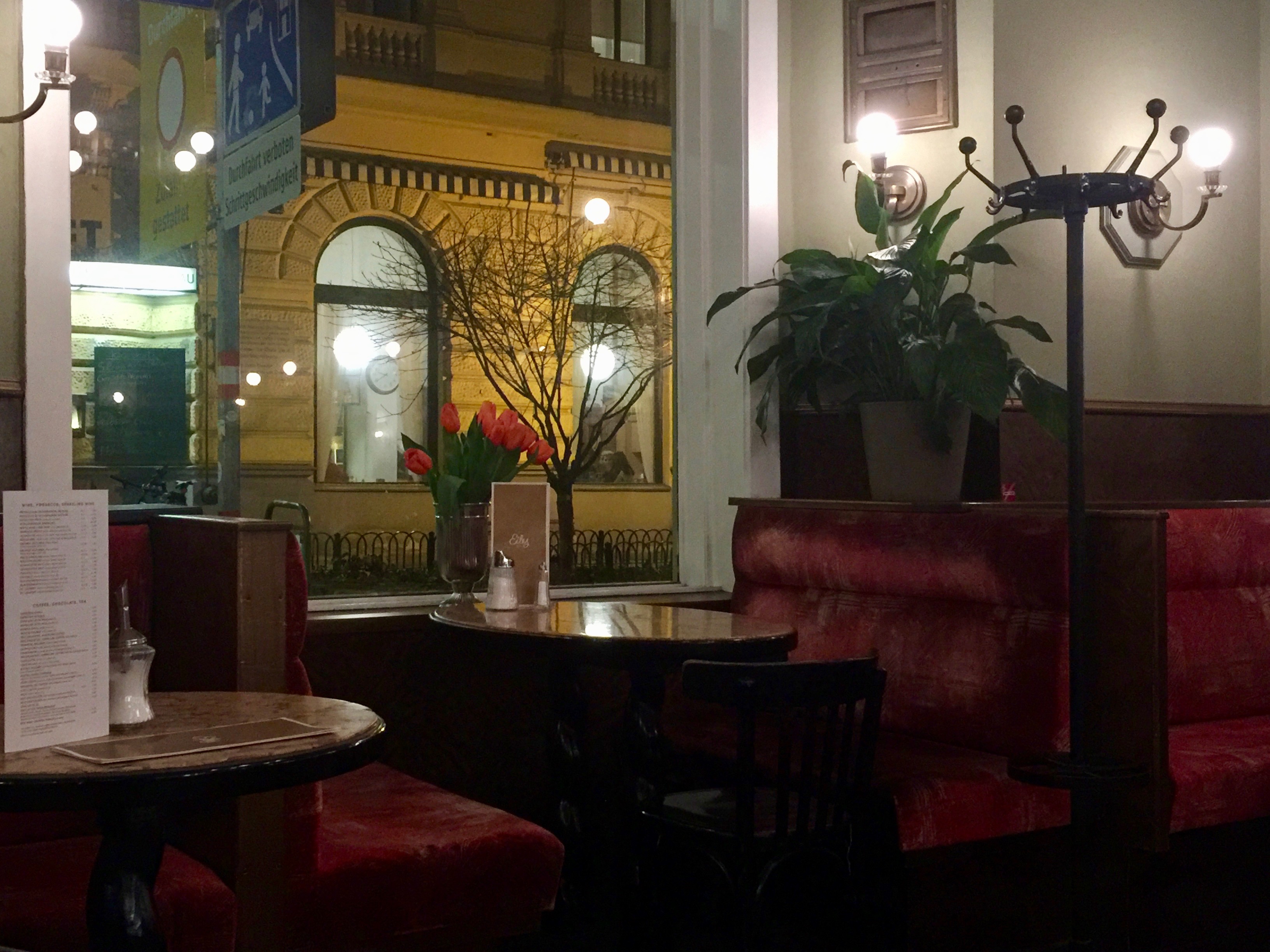
Interior of Eiles

The implied wiki wiki aspect of bistro cafés is, however, front-loaded. Once served and sated you can wait an unseemly while to attract the waiter’s attention if you need to get up and go, a feature which used to be shared by Parisian cafés, where they have now apparently decided they don’t want you there in the first place, knowing in advance you will want the wrong food, so please pay and leave.

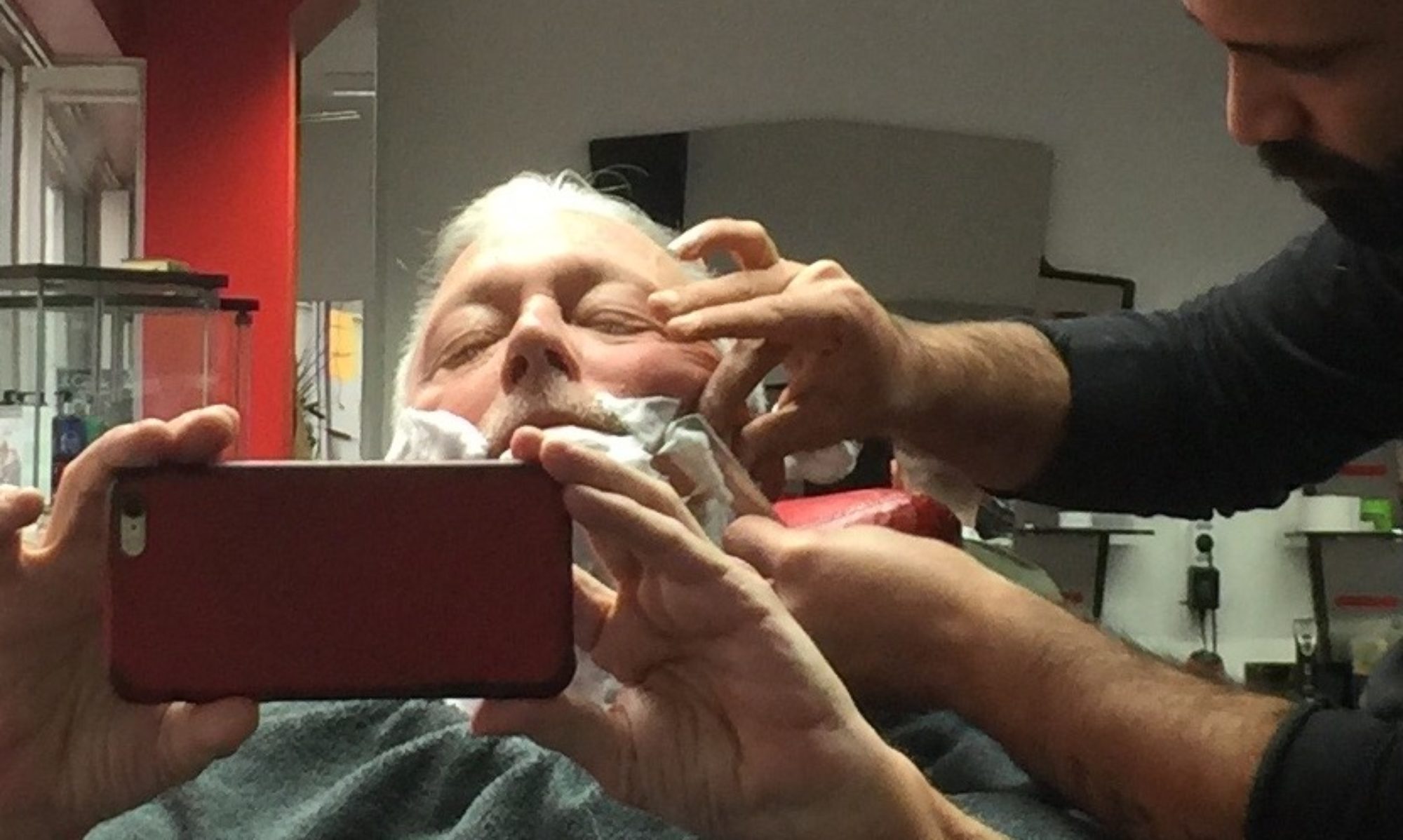
As the banner photo on the Eiles website shows, cafés in Vienna are bastions of upholstered comfort in which we are encouraged to linger. They are also strongholds of convention, everyone expected to conform to an implicit code of polite behaviour and set formulas of language, also to respect the traditional menu. I remember having once asked a waiter at cocktail hour, as I was enjoying a glass or two of wine with a friend, for a little dish of nuts or olives to buffer a bit the inebriation I felt rising within. Mein Herr, came the trenchant reply, “we are in Vienna in a Viennese café. If you want nuts or olives, go somewhere else.” A classic example of the Schmäh or acerbic wit for which the city is notorious.

True to form, Eiles offers standard regional fare, brothy soups in which potatoes or carrots or beets and other root vegetables play a prominent part, chives galore. Probably more salads now than back in the twentieth century, grilled and fried sausages and meats, always a schnitzel or two. And goulash. 

That Sunday night I had no fear of the digestive danger a heavy late evening meal might pose to sleep or dream. I wasn’t going to sleep anyway. So I plunked for the goulash and started with a modest Achtel, an eighth liter, of white Grüner Veltliner, actually green by name. I polished it off in a flash because I knew I would be moving on to one or more Viertels, quarter liters, of red Zweigelt. 

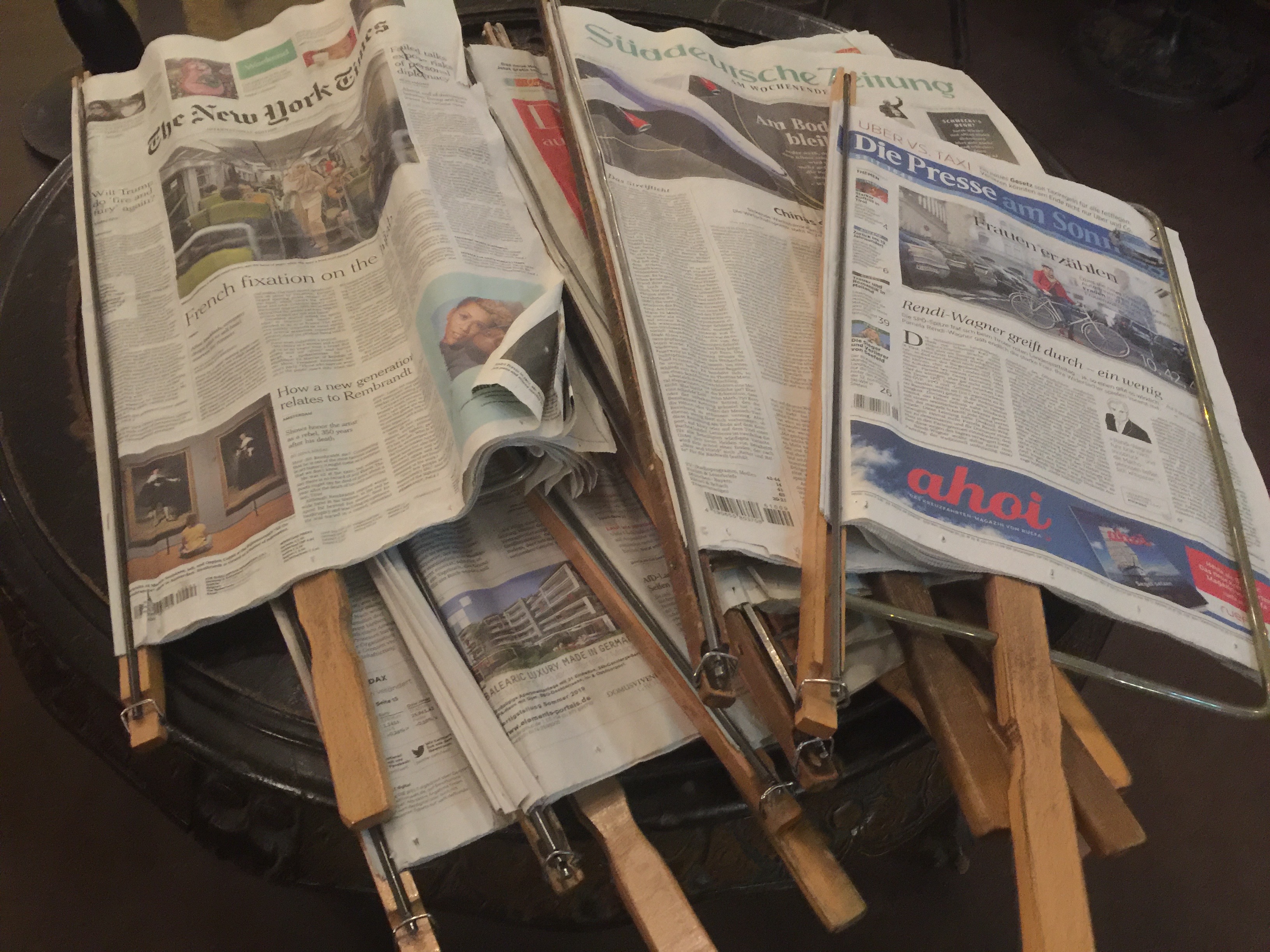
The goulash appeared quickly, as did the red wine, but I was in no rush. I had picked up a couple of international newspapers to browse through, a service still available in this literate setting, where free papers are bound in wooden slats and displayed on racks at strategic points. I intended to while away as much time as I could before confronting the hole of insomnia which would gape once I returned to my hotel with nothing to do but stare at the backs of my eyelids and toss and turn. Plus, cafés are inherently social spaces into which people come to watch other people, and to be watched.

Newspapers in Eiles

Austria, like most of Europe, is greying quickly. So I was firmly within the majority of senior and seniorizing citizens out on a Sunday evening for a slice of torte or similar delight and who ended up at Eiles. But we ancient ones were not alone. Viennese apartments are cozy but small and over 60% are owned by the city government which rents them to residents who earn less than 3,317 € a month, roughly $4,000. Monthly rents can easily be less than the 30% of income which financial consultants advise. That means at least some pocket change for entertainment. As in other big cities around the world, much life must pass on the street or take place in public spaces, of which a well-lit café is a perfect example, especially where winters are long and chill. So that Sunday evening there were also many not-so-grey-haired people who had met to chat quietly over coffee or cake. Some were even quite young. 

I mention all this because that Sunday night it was pleasing to the old fogey I have become to see young people so respectful of, indeed by all evidence seeking out the shelter of the local code of quiet conversation shared in the presence of others who might be browsing through a newspaper or even reading a book. It was a comforting place in which respect for others was a ground rule.

I tried nonetheless to eavesdrop on the table nearby, the four young Viennese whose demeanor and style had impressed me but also pricked something in my memory. Truth to tell, I was already a bit tight, having had about a half litre of wine by that point. That, and the fact that my German is far from accomplished, enough to get by on, read the newspapers and watch the news, enough sometimes even to make jokes, but usually lame ones. So the gist of their conversation was hard to grasp. I definitively heard passingly repeated something like “vay-gay”, though of course in German, so they weren’t talking about gender and sexuality, at least not primarily. A vay-gay is a WG, a Wohngemeinschaft, what the dictionary calls a commune, though the word has different connotations in English. 

Living in a WG is a standard rite of passage for many young Austrians. As best as I could tell this group was lamenting the sudden departure of a prospective WG roommate who had upped and decided to go back to Paris to finish a course he had abandoned. He hadn’t left the others in the lurch, having left rent for two months. But there was considerable speculation about his motives, mostly turning around matters having nothing to do with studies, inevitably affairs of the heart and/or its nether attachments.

View out of Eiles, 22h. Booth soon to be filled.

I had the odd feeling they were talking about me, though they couldn’t have been. Then it dawned on me. My personal history with Vienna goes back a long way, to Christmas of 1972. That year I was based in Paris but had tired of being there. Through a friend of a friend I was invited to Vienna where the sister of the second friend was willing to put me up for the holidays. I was excited by the prospective change of setting and had seen a photo of the sister in question, Bettina, who had a decidedly erotic appeal to my overheated twenty-six year old imagination. Why not? I had enough money to take the train, a full twenty-four hour trip in those days, and the freedom to move to and stay in Vienna if things worked out. 

That was my first encounter with the ethos of a WG. The roomates agreed that I could stay on a spare sofa in the shared living room of Bettina’s for a week if I contributed expenses to the common kitty. The question, I gathered upon my arrival, was left open whether I would move into Bettina’s own private room.  

I never did. Instead, ten days later I got back on a train for Paris, intending to collect my things and take what money I had out of the bank and return to Vienna. In those days there are no easy way for an impoverished student to transfer money from Paris to Vienna. Yet maybe I had left the account open in Paris to hold myself hostage, to make sure I’d come back. 

I was entranced with the gritty, culturally rich Vienna of 1972. Yet I remember clearly the moment I came out of the métro at Odéon, right in the center of the Left Bank. I looked around at the bustling scene and instantly decided to stay in Paris, where I lived out the year as planned. It was a hard letter to write back to Bettina, with whom I imagined I had unfunished business, as well as the other friends I had made in the WG.

Below is the link to a short story I wrote in my klutzy German a few years back, Schlafsofa, a fictionalized version. There is probably more truth in it and its translation Spare Couch than in this account of what actually happened. In both the real and the fictional versions, I gave up the chance to live in Vienna, a city I have since repeatedly visited but have only friends, no lived roots in, only memories.

That Sunday evening in Eiles thus ended in soppy nostalgia. The ensuing hours of fitful wakefulness were full of bittersweet contemplation of what might have happened almost a half century ago.  Could have, would have, should have are often the cryptic topics of jet lag, which is always about being where you aren’t.

Spare Couch /  Schlafsofa