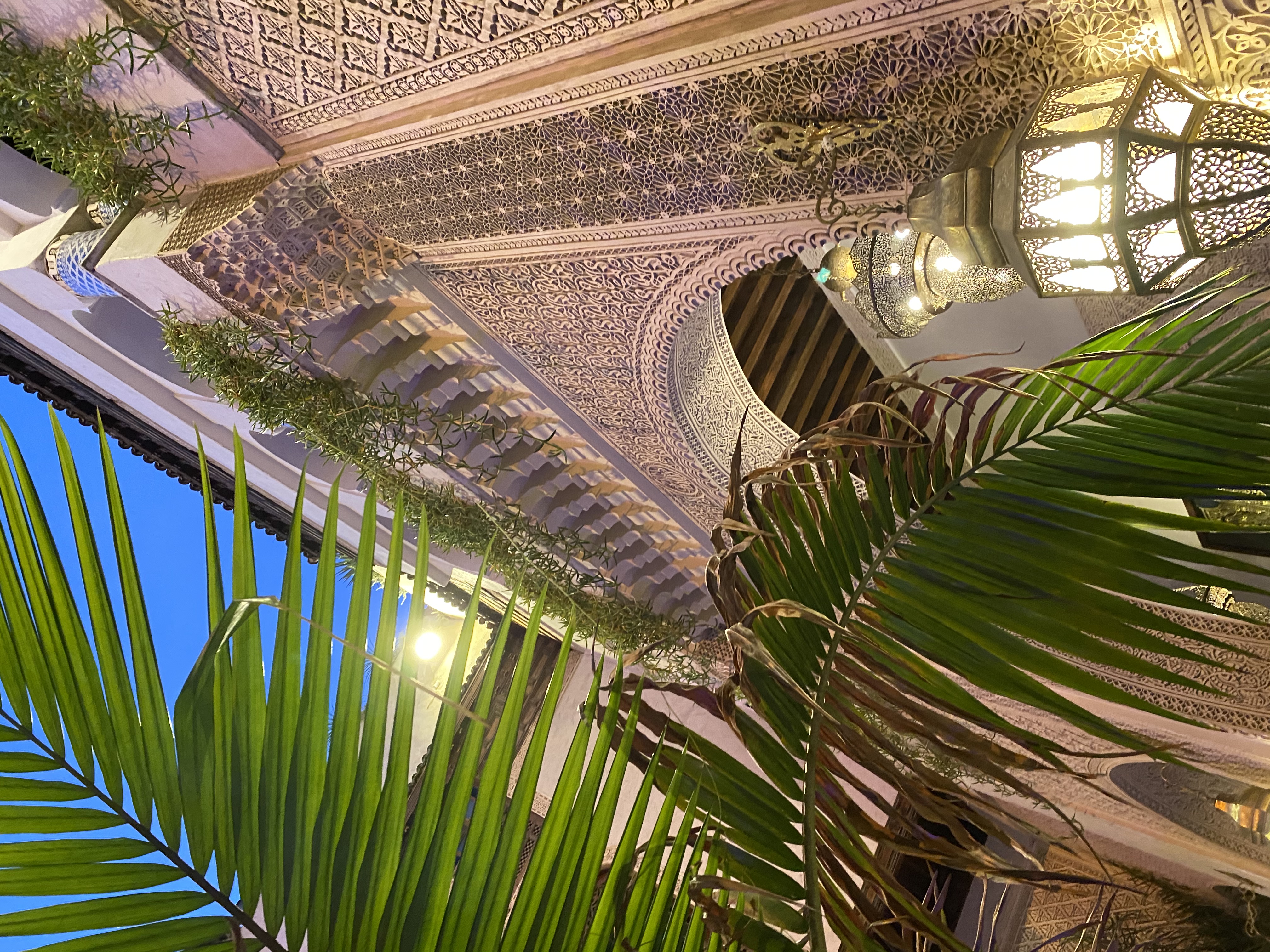
Far be it from me to herd the curious into joining Instagram or any social network. I have learned to use them, IG and Twitter and to a lesser extent WhatsApp, as writing tools, media which shape our experience and invite us to express ourselves, though within their own inherent limits. But I have put this page up for those have asked for my impressions of Morocco but are not on Instagram, into whose language and on which platform I kept a travelog of our trip to Morocco.
So follows a compilation of my IG posts during and shortly after our Xmas trip to Morocco. They can be read without signing on to that Facebook-owned medium.
Yes, behind every IG post is a free-floating webpage. In fact, that’s what social media was derived from. Before the advent of Facebook et al, to have a webpage or a blog of our own we had to learn how to write in, originally, HTML.
I did so starting in 1994. Back then the internet had yet to be captured by venture capital, democratized, commodified. Now it’s also become a rampant source of demogoguery and propaganda, plus a lot of silliness.
A picture is worth a thousand words, goes the adage. I am pretty verbose for someone on Instagram, but I try to get by with under a hundred words per post.
*
Dancing Gnawa in Tangier. I was once a better dancer, but this vid of my jiving in the Caves of Hercules near Tangier was for me a first shock of recognition that Morocco is indeed part of Africa. In fact, it has had a millennia long relationship with the Sahara and the Sahel, hence my approximate feel for this Sufi-inspired music as someone who spent two years of my twenties living and traveling and yes even dancing in West Africa. https://www.instagram.com/p/B7mmOLzheL-/
Casa 1: Hotel Le Doge. Our modest art deco hotel in Casablanca bills itself as a haven from the surrounding chaos. We deliberately chose to shore up there for four nights to wait out the effects of jetlag. I was happy to be in a French-speaking environment, which I miss sometimes desperately in California. Ironically, we were assigned the Fritz Lang room in this art deco themed hotel. https://www.instagram.com/p/B6P-9iTh62D/
Casa 2: Here is the view from the terrace restaurant and bar of Le Doge, where we repaired regularly in between bouts of drowsy, uneven sleep and sporadic sightseeing. Outside were trees familiar to us from California. In fact, the weather, at least in winter, is similar to that in SoCal. https://www.instagram.com/p/B6TnIQGBGGz/
Casa 3: Near the mock-up of Rick’s Cafe, a favorite watering hole for expats, there is a major site to see in Casablanca, the Hassan II Mosque, the third biggest in the world. Islam feels to me to be an astonishingly coherent and consistent religion, here emblematized by impressively scaled architecture and the artful design of this monumental mosque. https://www.instagram.com/p/B6VqPCbBwLg/
TGV from Casa to Tangier: I wasn’t kidding when asked before our departure what I was looking forward to in Morocco: I want to take the TGV (Très Grande Vitesse = bullet train ). I wasn’t disappointed. Getting off in the new terminus in the middle of “Tanger nouveau” was a welcome change from gritty Casa. https://www.instagram.com/p/B6bHt_IB2rG/
Tangier 1: Another reason I offered before we left as to why we were going to Morocco was: to escape US Christmas. That hope too was not frustrated. https://www.instagram.com/p/B6cPO2GBnjg/
Tangier 2: Xmas morning we met up with Wahid Chmacha, our trusty guide through the rest of the trip. He took us out to the coast along the Straits for a casse-croûte of bessara, a hummus-like dip made from fava beans. Although distant on the horizon, Andalusia, the lost half of Morocco, looms to this day over the Moroccan imagination — much like the Western US in the Mexican mind. In this case, Morocco lost Andalusia, but, I kept thinking as the trip went on, Spain lost the beauties of Morocco, apart from what remains in Grenada and Cordova. https://www.instagram.com/p/B6gOh3VhX1A/
Tangier 3: Spices in the souk of Tangier. The little seedheads in the middle are, Wahid informed me, not technically a spice, rather a source of toothpicks. There is also a baklava-like dessert named for its resemblance to the seedhead which is a feature of Ramadan late evening repasts. https://www.instagram.com/p/B6kTVuEhBvz/.
Tangier 4: The Riad Mokhtar, high up in the casbah or old fortress of Tangier, was virtually empty over Xmas. Here we met Djalo from Guinea-Bissau, a country whose creole I studied. He works as a jack-of-all trades for the French owner. By the time we left he was calling us “family”. https://www.instagram.com/p/B6kVEWbB7HX/
Fez 1: We were lucky to have one of our meals at the Dar d’or, a riad owned by a Moroccan couple where I finally was able to have harira, another Ramadan-tinged treat. I’ve already made a version of it back home but I’m sure I’ll never capture the subtle spicing of this exqusite bowl of soup. https://www.instagram.com/p/B6pT5QJhBUM/
Fez 2: The rooftop terrace of the Riad Salam in Fez offered me a celestial reflexion which I didn’t realize I was having until the next morning after the moonset, when I saw the delicate light of dawn in the opposite direction. https://www.instagram.com/p/B6ri5oTB5eF/
Marrakesh 1: Wahid, whom I loved teasing by calling him Monsieur GPS, also is an encyclopedia of prospective camera angles and shots. Here he escorted us up to the rooftop terrace of a cafe overlooking the main plaza of Marrakesh, the hallucinogenic Place Jemâa el-Fna. He took the video himself. https://www.instagram.com/p/B6ugeE5B-yW/
Marrakesh 2: A third goal for this trip was a cooking class. At the morning-long session at the Maison arabe we made tagine of chicken with olives and preserved lemons. I rarely like the food I make, eating it at table I mean. But I did eat what I made and will be making it and its many cousin tagines regularly in the future. https://www.instagram.com/p/B6voF2EBKJ2/
Happy 2020: Thoroughly Islamic by religion, Moroccans nonetheless celebrate the New Year. Wahid whatsapped me this across a cafe table on the day itself as we were sadly en route back to Casa. https://www.instagram.com/p/B6yRrR2hZOM/
Kitties of Morocco: This compilation of kitty snaps, severely edited for reasons of space and not including those Nasrin herself took, speak to the many felines of Morocco. There are some very lucky kitties there. Imagine the life of a riad cat. Also, alas, there are many unfortunate ones. A parable, perhaps? https://www.instagram.com/p/B6z0QgMBk8D/
The Riad Salam Fez: Easily the most spectacular of our abodes on the road was this refurbished and fully renovated five-star in Fez. This one took ten years to restore, opening in 2010. What is a riad? Wiki knows: https://en.wikipedia.org/wiki/Moroccan_riad. The Riad Salam, as one can see here, is spectacular. https://www.instagram.com/p/B64J_-YBoUO/
Literary Tangier: I had set as yet another goal a visit to the scenes frequented by Paul Bowles and the US beat and other writers of the fifties, Gore Vidal and Tennessee Williams among them. There is a small wing of the American Legation Museum in Tangier devoted to Bowles, where I snapped this photo and meditated on a slightly older generation’s lives. https://www.instagram.com/p/B69IwzCBa4j/
Chefchouan: The Blue City on the route from Tangier to Fez is a famous site for selfies, which I’ll spare you. Crowds with selfie-sticks jostle for the best place to take pictures of themselves, not always aware of how rude they are being to those who don’t want any people at all in their own photographic mementos. https://www.instagram.com/p/B6_vfU4BgZa/
At the Pottery in Fez: An unexpected treat was a visit to this pottery and mosaic factory outside of Fez. https://www.instagram.com/p/B7CdmGBBbms/
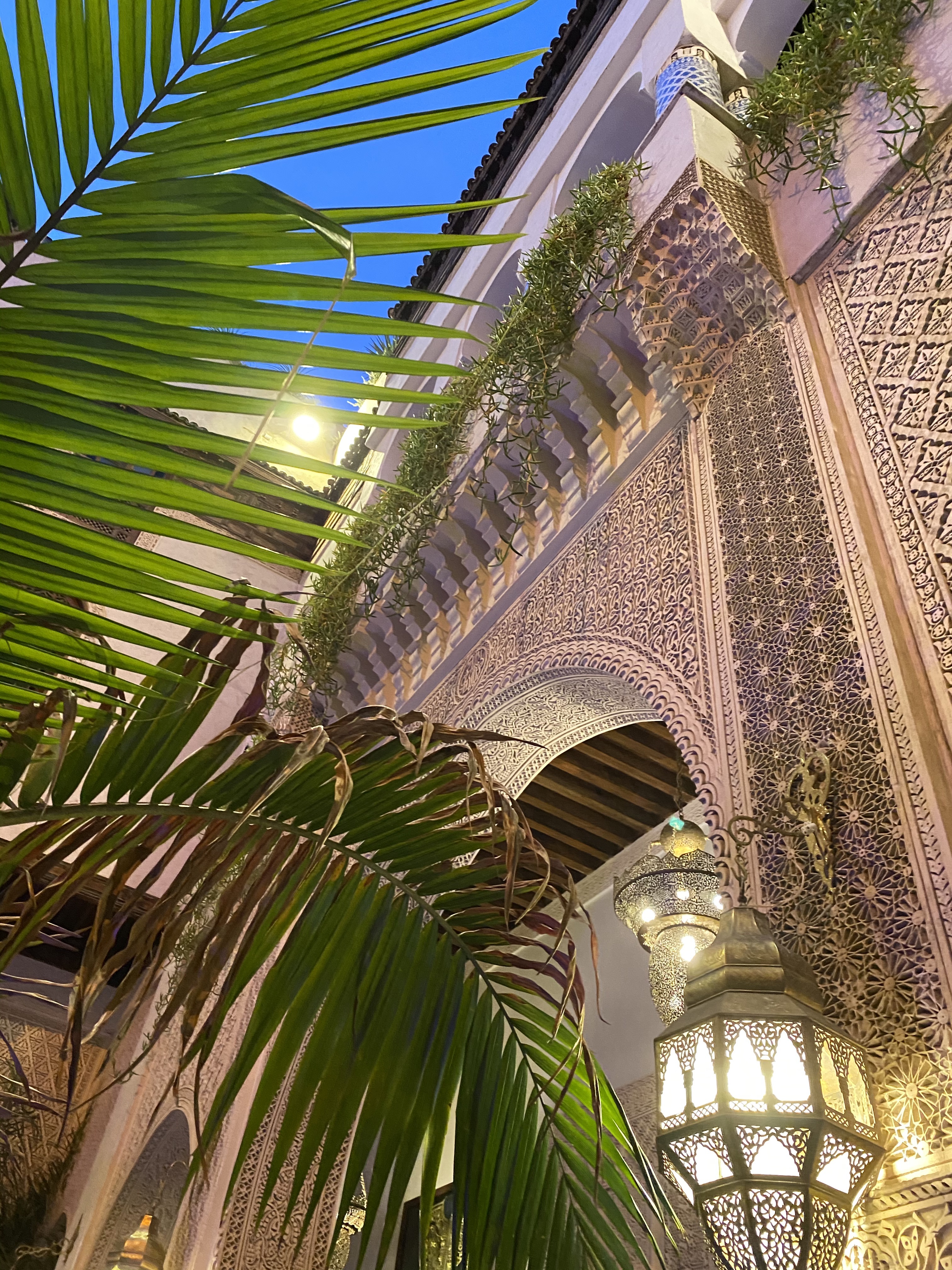
Parting shots of design detail in and around Fez. All good things must come to an end. My archives are full of photos. I would have spent hundreds of dollars on film in the old days – Kodak’s loss, our gain. Memories abound. I hope they will always remain. https://www.instagram.com/p/B7FD3nih1rr/
*
I am planning a more traditional blog text, The Not-So-Sheltering Sky. Coming soon to this site. Stay tuned.