The Cathedral at Cuetzalan del Progresso, Puebla, Mexico
Friends in Laguna Beach who are lucky enough to have a wild avocado tree growing above their modest terrace right near the beach casually passed on a specimen of the perfectly ripe fruit which fall down upon them. I could try to describe the sensations of tasting it, but this choice of words already tells you I am talking about more than mere flavours. Let me put it this way: its impact was immediately destructive of time and place.
Now that is what I call food.
I was beamed not necessarily up but at least back thirty years to when I used to hang out with my friend Richard in the cloud forest of the Sierra del Norte in an old colonial town since become very touristy, Cuetzalan del Progresso. We ate so many avocados that I forgot their ubiquitous presence in our diet.
It turns out that the Mexican group of avocados evolved in the “relatively cool subtropical highlands” there (per Harold McGee). This perhaps explains why they are so happy in Laguna Beach, which, California Dreamin’ aside, is submerged most of the time under the chill of the Pacific marine layer.
A few posts back I put up the image of an avocado carved for the Day of the Dead like a miniature jack-o-lantern. It was a poor little pebbly-skinned Hass avocado, which stems from the Guatamalan family and is the sub-species chosen by the food industry for sacrifice on the altar of super-marketing. Dressed with sufficient garlic and spices, they do have some taste.
But what I had for dinner tonight was something of a different order, though roughly the same species. One bite and the above image flashed before my ears, the view over the zócalo in front of the cathedral in Cuetzalan from the little posado where I would transition during my visits.
For the record, avocado comes from the Nahuatl ahuacatl, which means testicle.
No: I am not going to concoct a recipe for a fricassé of mountain oysters in chipotle avocado sauce. This would be beyond the bounds even of glossy Bon Appétit food porn.
One raw real living avocado with a scattering of pepper, salt and chopped onion plus a sprinkling of freshly-squeezed lime was enough to produce tele-transportation.
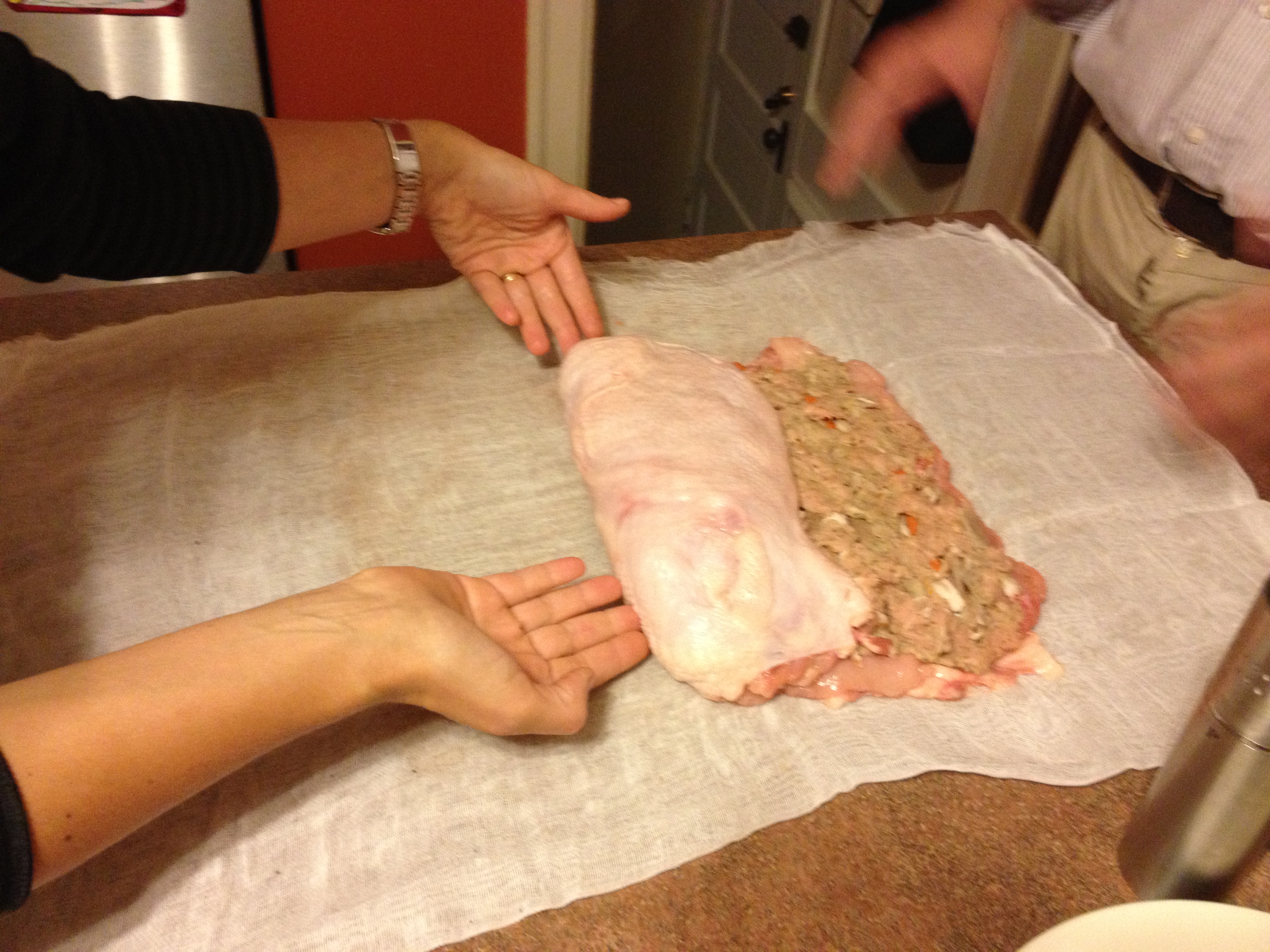
The galantine in its swaddling just before poaching
A strong tinge of nostalgia comes with the notion of comfort food, though the food industry has striven hard to persuade us to indulge in the novelties they purvey whenever we seek not just nutritional satisfaction but psychological solace.
Our parameters are nonetheless largely set in childhood, as far as the nutriments go, which is no doubt why fast food, however it seeks to titillate with semiotic originality and to seduce with salts and sugar, remains within the confines of convention, replicating roughly recognizable shapes and forms of carbs and protein.
Apart from pumpkin pie, baked beans and gelatine deserts (score one for Jell-O), there are few vegetables on the standard lists of American comfort food, with the exception of Ronald Reagan’s ketchup. Some of us keep trying to persuade ourselves that salads deliver comfort, but the case just doesn’t stick.
I began thinking about what makes food comfortable during a recent weekend with old friends in Winnipeg, the culinary capital of southern Manitoba. That’s in Canada, let me add for geographically challenged Americans, less than a hundred miles north of the Minnesota-North Dakota boundary.
Over the years we have shared meals with Paul and Natascha in Alberta, Ontario, Germany and, memorably, in Tuscany. We have also shared preparing many of those proceedings. Paul and I regularly exchange email notes on what we’re rustling up, which expression signals much about our ideal diet, so to some extent we are cooking together even when we are thousands of miles apart, the way it has been over the past two decades.
Of late the two of them have become more adventurous than I am, inspired in particular by Richard Olney’s Time-Life series from the seventies, dauntingly its volume on Terrines, Pâtés & Galantines.
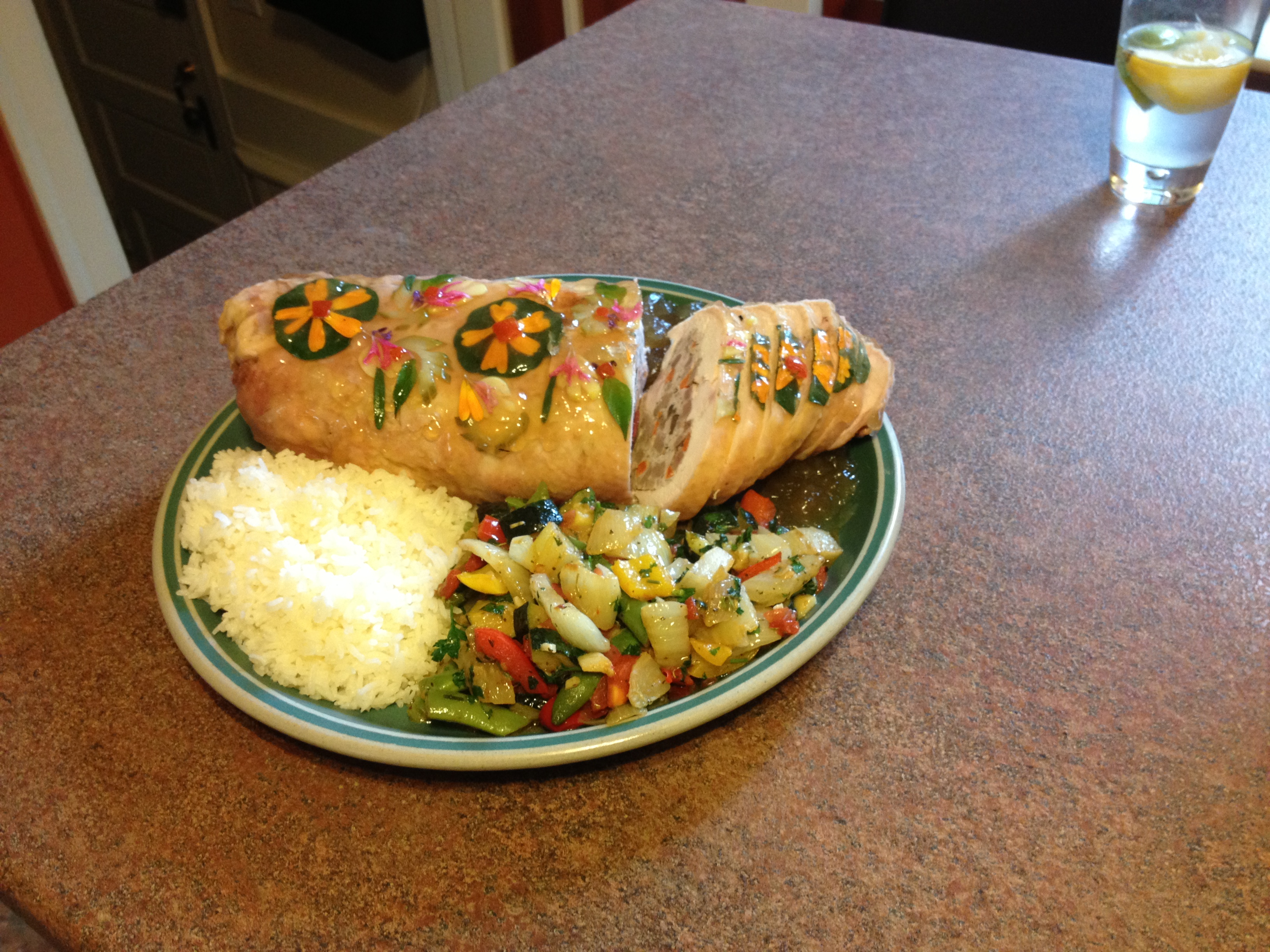
It is flattering when friends devote time and energy to a production like galantine, this classic of haute cuisine. Although related to charcuterie in general and based upon ancient techniques of preserving meat, thus not in the least fancy in its roots, galantine is now a show-piece involving multiple steps and procedures. The end result is a composite loaf of various meats and vegetables poached in a gelatinous stock which then, even further reduced, becomes the jelly or aspic used to decorate and accompany it.
When Nasrin and I arrived on that Thursday night, much of the prep work had been done. The forcemeat was in the fridge and the stock had been simmered for long hours in the early part of the week. But there remained two evenings of work before we could sit down to devour it on Saturday night.
I say “work” but this was more like fun.
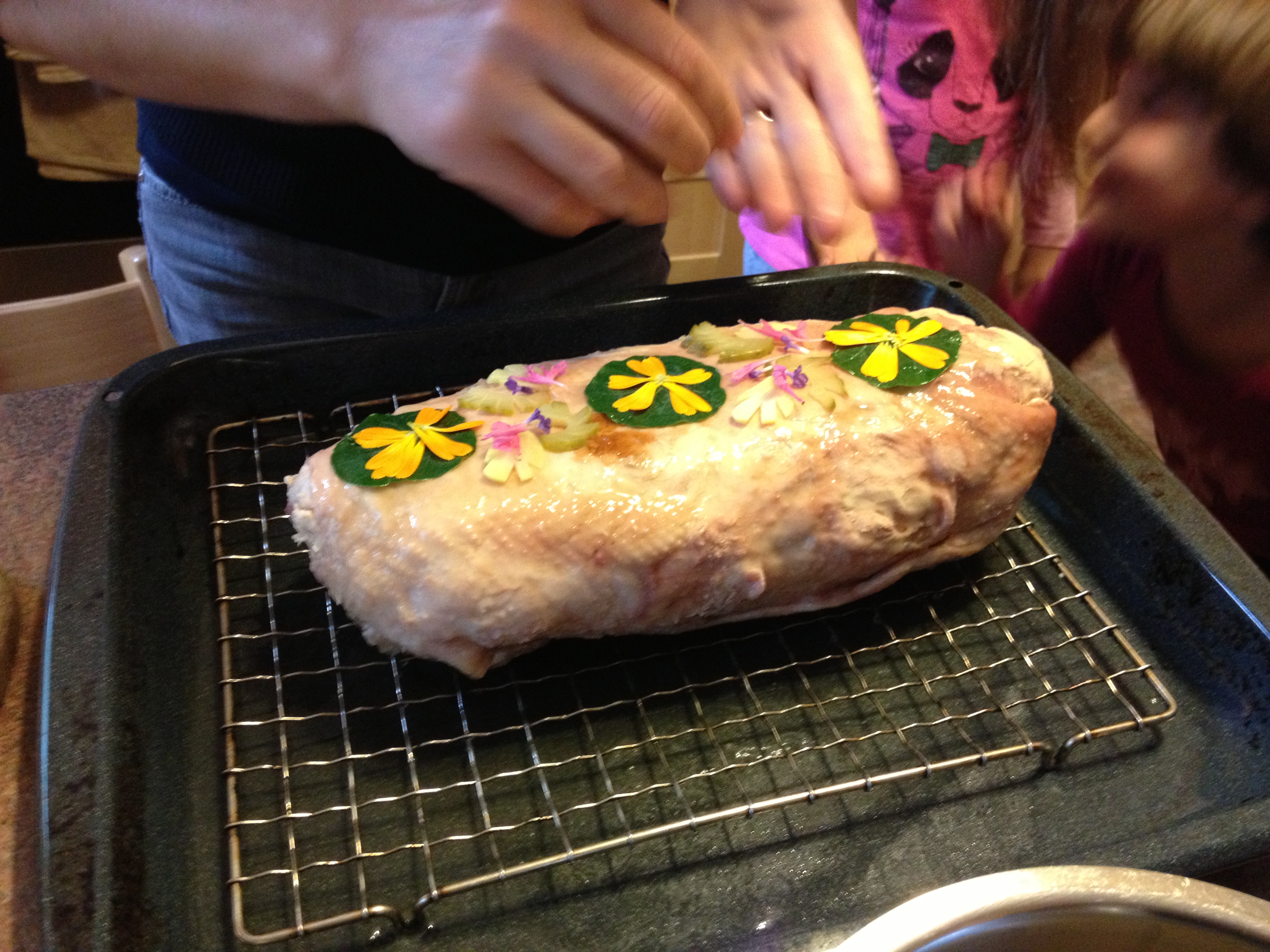
Considerable wine and some cognac was consumed as Paul boned the chicken, Natascha rolled the ensemble in cheesecloth, transferring the cylindrical loaf into the broth, though allowing me briefly to cuddle their baby for the photo above. The next afternoon she took charge of the decorations, applying herbal leaves and edible flowers from her garden. Paul spooned over and let congeal, one after another, the several layers of aspic necessary to enclose and seal the pattern.
The reader will gather that my role was strictly that of play-by-play commentator. Throughout our visit, it followed that Paul and I pursued a sporadic conversational thread on what galantine was and should be, with references not only to the Olney recipe which was their guide, but matters of related interest: Escoffier’s discussion in his Guide culinaire, the other aspic creations in Terrines, Pâtés & Galantines, the fact, which became apparent the more we talked and pulled books out of his trove, that Olney was himself engaged in a dialogue with Escoffier and others when he put this version of galantine at the climax of a volume which is probably among the least popular of the twenty volume set, after Variety Meats, or, as it was called in the British edition, Offal. I suspect this relative neglect also affects his virtuoso description of how to make an aspic in Simple French Food, a title whose irony still brings a smile to my face, and which I highly recommend for those interested in food writing.
In a sense, Olney too was cooking with others, and knew he was. Paul and Natascha were cooking alongside him too, the written words of all these recipes serving as the only intermediary possible.
So what is comfort food?
After the galantine of a weekend we spent in Winnipeg, I would offer the following definition: food cooked and consumed in the presence of old friends and in the self-conscious virtual, be it only verbal, presence of all those who have shared in your making of your own repast.
Boning the chicken
The boned chicken flesh
Rolling the flesh and forcemeat in cheesecloth
Next day, after poaching, decorating with the help of spoonfuls of melted jelly