The Giraffes at San Gorgonio

The moon is warm tonight, not breeze
enough to stir the vanes of the wind mills
grouped in groves of their own out beyond
the manicured lawns and stands of palms
which ring this landscaped spa oasis.

I take them first as sunflowers basking
in a pewter glow, swinging toward
not light but the slightest waft, their roots
seeking the moisture said to seep along
the fault deep under this parched basin.

Then before me there prances among
the baobabs on the dessicated bed
of some Lake Chad a herd of giraffes,
their graceful gait stirring flocks up into
fluttering flight, the piebald quilts of their

dappled hides furling like ships’ sails,
spangles on water where there is none.
As they lope, they dream of other giraffes
inscrutable dreams I can never know
even as vaguely as I know my own.

Today you looked especially sad, pale
arms clasped to your calves. Hush, I said.
No tears out here! Stop believing in rain!
Imagine instead flowers as giraffes, baobabs
as tumbleweeds perched atop thick stalks.

***
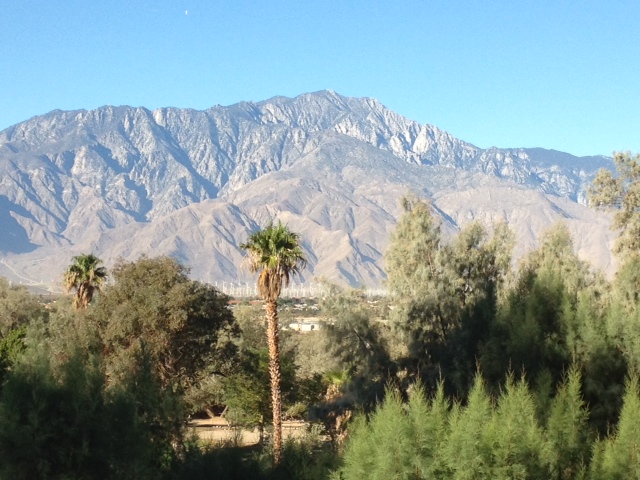
The San Andreas Fault lies beneath San Gorgonio Pass, which leads from the L.A. basin to the valley in front of Desert Hot Springs. One of the deepest gulches in the contiguous U.S. states, it hosts a vast wind farm. My poem echos Nikolai Gumilev’s “Giraffes” but is not a translation of it, as you can see at http://max.mmlc.northwestern.edu/mdenner/Demo/texts/giraf.html. Thanks to E.K. for her 1984 gloss of the Russian, the learning of which this poem in the original alone would have made worth the while.

Here are the giraffes at morning under San Jack, at 10,834 feet / 3,302 m a subpeak of San Gorgonio at 11,503 / 3,506 m. 
Giraffes under San Jack


Envoy

Write woman’s words on water swift,
on wind worn thin with vow.
Here mine are in black on white,
though parchment yellow, vowel shift.
In these poems I dubbed you thou
though you gave me such short shrift.

In our embrace I thought I clutched
the pulse that throbs in veins, no sham
beat which rhyme and feet prolong.
With these words let proof be clinched
sting too can send a dithyramb.
I sought more than paltry song.

Fallen leaves which leave behind
a pang each day renews,
my poems on something bright and quickly
drawn away were better in my mind.
I am done with you, my Muse,
now that you are through with me.

***

An envoy or envoi is a stanza appended at the end of a poem, a coda. They are traditionally addressed to an imaginary or an actual person, often a Patron or a Lady Love, in different settings the poet’s Muse.

Rest assured that there was an original addressee though she was ultimately only a minor muse. There remain fragments and heart-shards of the poem I once started out to write to her, something of a grievance, an ancient and noble poetic convention. This poem was however addressed from its beginning to Catullus, the opening lines of whose Carmina 70 are mine in translation:

sed mulier cupido quod dicit amanti,
in vento et rapida scribere oportet acqua

Write women’s word on water swift,
on wind worn thin with vow. 

Before anyone gets too wrought up with the latent political incorrectness of this assertion, let me state that when I wrote it I had decided never to write another poem. This envoy was to be my goodbye to poetry itself. Herself?