Quarantine, 1968


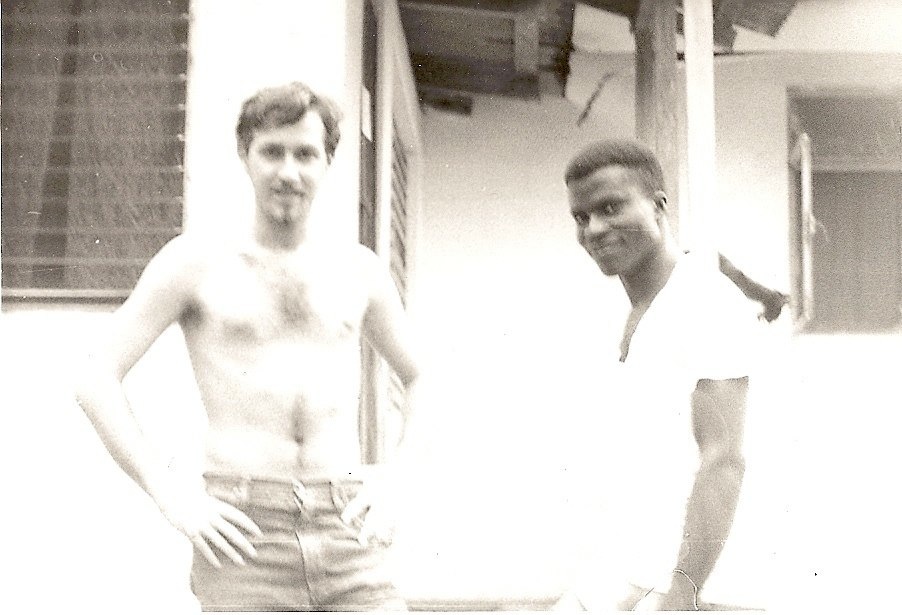
I was “dry-o” when I emerged from quarantine in Liberia. Here with Arthur, summer of 1968, 125 lbs

I spent most of May 1968 in quarantine on the campus of Cuttington College in upcountry Liberia. I had contracted infectious hepatitis “A”. I like to imagine it was from drinking water from the Niger River on the way back from Timbuktu a couple of months before. 

I was couped up in a empty house on the edges of the campus in middle of the bush with another Peace Corps teacher, Jim, who was an economist and who had been diagnosed with the same affliction. We had separate rooms and were brought food and boiled water twice a day by Roosevelt, my then houseboy, who was deemed to have already survived it and therefore not susceptible.

Roosevelt, 1968

Otherwise, we were completely isolated. Jim and I were not even supposed to interact. In any case, we were both confined to bed and didn’t have a lot to say to each other, lost in our separate deliria. 

Until the fever broke, I had little interest in food, reading or anything except self-pity. But after I improved and began to suffer boredom, I was delighted with the arrival of a stack of the New York Review of Books going back to 1967. James Olney, the chair of my English Dept there, had sent them along with cheerful greetings. He had been an early subscriber and they had been delivered via slow post to Liberia. I was delighted when I found James again at UC-Irvine in 2010 and discovered that he still subscribed.

I read through the pile voraciously just as news began to reach me via shortwave radio and weekly arrivals of the onion-skin-like international edition of Time about the assassinations in the US and surreal events on the streets of Paris. News about Vietnam was no longer news to the males in our little cohort at Cuttington. We had ended  up in Liberia in part because of calculations around the draft. Without the least idea how things would work out, we were all planning our post-African lives around that stupid war.

On top of the stack was the notorious issue whose cover depicted a diagram with instructions to make a molotov cocktail.
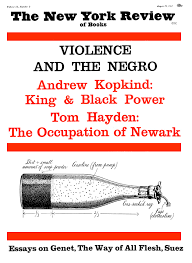
The 24 August, 1967 issue of the New York Review of Books

Suddenly, I felt I had reason to live, not because I seriously intended to construct such a device, but because I momentarily felt there was an intellectual culture out there to which I could honorably belong, even though I already knew I would be leaving America behind.

1968 didn’t turn out at all as we  youthful rebels hoped and I have to admit I am doubtful that by 2021, or whenever the covid pandemic runs its course, the world will yet have learned a thing.

Still, it is with more than soppy nostalgia that I look at that ancient NYR cover and reimagine the state of mind I entered once I left quarantine. 

Imagining post-quarantine is surely a useful mental exercise for us all in the present moment. Not because things will change, rather because our wanting them to change is part of who we are. 

Pascal’s Conditional, Subjunctive Wager

Since the age of sixteen, I have entertained discussions with a friend it would not be wrong to call a theologian. For most of our adult lives we were out of touch, though he was often in my thoughts the way everything and everyone have always been in our thoughts when we come to think of them again.

Last year, we renewed contact and naturally re-engaged with our debate.

One of his thrusts or parries led me to reflect on other stages of my life in which I had not only concourse but friendship even intercourse with religious persons, learning to speak the terminology of theology and doctrine with them in order to communicate.

His question turned around Pascal’s wager that each and every human bets that God exists or not. Given that such might be the case and taking into consideration the infinite gain or loss associated with belief, unbelief or disbelief in said God (an eternity in either heaven or hell), Pascal held that any rational person ought to live as if God exists and seek to believe in Him. If God did not actually exist, such a losing gambler would suffer not infinite but mere finite loss, measurable because imaginable, pleasures more likely than not sensual, and measured in the end against an infinity in hell.

Though admiring Pascal’s logic, which contributed to probability theory, I was never happy with his assumption that we could “pretend as if we believe” and God wouldn’t know or care about how false any virtue we thereby attained might be. This attitude betrays my Protestant orientation, since I presume that a relationship with a god or even God would be not only personal but sincere, without mediation.

The most telling description I ever heard of this “knowingness” of God was not from a Christian, rather a Muslim, the Imam of one of the first mosques in North America, Al Rashid, founded in Edmonton in the 1930s. In 1986, I ceremoniously converted to Islam in order to marry Nasrin legally in the eyes of the Iranian government — a legal procedure which facilitated her life and lent her a margin of safety in the early years of the Iranian Revolution, when she had to travel back for family reasons. The Sunni Lebanese Imam who married us and who filled out the documents she submitted to the Iranian Embassy in Ottawa was doubtlessly aware that my conversion was factitious. At one point in our discussions about Islam he assured me that it was not important to him if I were sincere in my conversion, since that was a matter between myself and Allah. Allah would know, when the time came to know, what I really thought.

The notion of a panoptic deity is a terrifying one, even more disturbing than that of a panoptic state, of which one extreme model is the eighteenth century prison which Jeremy Bentham imagined and about which Michel Foucault later wrote. Foucault was the consummate Parisian intellectual, hence bore within the crypto-Protestant strain of Catholic Jansenism, which remains strong among that national elite — one reason French Communism sank such deep roots. In his later thought, Foucault shifted towards a more orthodox perspective, arguing that confession to a human authority was the ultimate instrument of power and also of truth about one’s self, not observation of our acts. In other words, truth is institutional, not located in one’s own independent thoughts about oneself or about God.

This passing, peripheral reflexion on privacy and confession is, I would argue, relevent in this age of social media, selfies, and mass collection of that upstart deity, data.