Au Cabaret-Vert, cinq heures du soir

This is the way I like it. Near the end of Season One of the French TV series Chefs, there is a culinary show-down, Iron Chefs style, which turns around a 1870 sonnet by the prodigy Arthur Rimbaud, written when he was turning 17.  I had always loved this poem, simplicity itself, Rimbaud’s point.

After I woke up this morning my rhymed translation fell into place before lunch, the last rhyme knitting together during my post-prandial nap. [And thanks to J.A. for a deft suggestion.]

      *

For a whole week I’d been wearing out my soles
tramping down rocky paths. When I got home
I headed to the Cabaret-Vert, ordering rolls
with butter and a slab of lukewarm ham. 

At peace, I stretched my legs out, admired
the simple patterns on tapestry hung
on the wall. Then the girl served up the desired
buns, her tits big, bright eyes so young 

— not likely would she shy away from a peck!
The pink ham with its rim of white fat bedecked
with pungent garlic sat on a fancy dish.

With it she brought a stein topped with froth,
spume glistening in the sun. In truth,
there was little more I could ever wish. 

      *

Depuis huit jours, j’avais déchiré mes bottines
Aux cailloux des chemins. J’entrais à Charleroi.
– Au Cabaret-Vert : je demandai des tartines
Du beurre et du jambon qui fût à moitié froid.

Bienheureux, j’allongeai les jambes sous la table
Verte : je contemplai les sujets très naïfs
De la tapisserie. – Et ce fut adorable,
Quand la fille aux tétons énormes, aux yeux vifs,

– Celle-là, ce n’est pas un baiser qui l’épeure ! –
Rieuse, m’apporta des tartines de beurre,
Du jambon tiède, dans un plat colorié,

Du jambon rose et blanc parfumé d’une gousse
D’ail, – et m’emplit la chope immense, avec sa mousse
Que dorait un rayon de soleil arriéré.
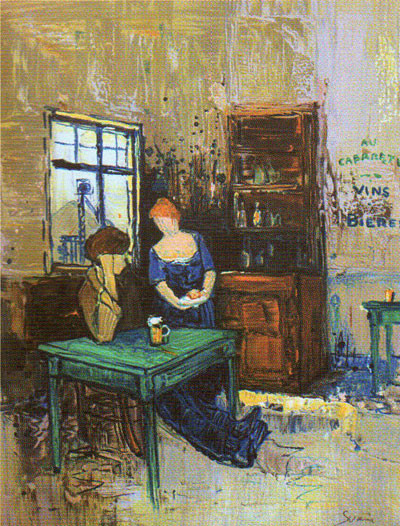
“Le Cabaret-Vert”, du peintre ardennais Jean-Paul Saurin


Yours truly at Rimbaud’s tomb, Charleville, 1988


Lozeau’s Azure

I stare and fill my eyes with your light,
o sky devoid of trace of cloud,
pleasure unutterable, unavowed,
as azure beams converge in my sight.

This blue swells like a river inside,
a freshet rising up to the brim.
Immensity, without boundary or rim,
floods my humble soul, bearing it pride,

opening within, by sheer vibration,
a space made mine through contemplation,
who am a mere atom in vacuous space.

This deep blue, this torrent of eternity,
rolls on and spills into inner infinity,
as, dazzled, I watch myself evanesce.

***
After Albert Lozeau, «Lumière» Texte français

The bare mention of azure tips us off to what Lozeau (1878-1924) was reading in Montreal in the early years of the twentieth century. Are metaphysical yearning and, it follows, angst restricted in time or place? This is a question the largely bed-ridden poet seemed to be answering just by asking it in Canada. In any event, I have never seen azure more pure than that radiating through a mid-winter high pressure dropped down from Hudson’s Bay and settled onto the St-Lawrence. 

This and another translation of Albert Lozeau initially appeared in earlier versions in the bilingual poetry mag, Ellipse 38 (1987). They could well introduce a sequence of translations of depressive Canadian poets who wrote in French, including Émile Nelligan and Denys St-Garneau. This is a breed with which I felt much affinity in those years. On at least one occasion I partook of this same depressive mode in my poem Québec.

Yes, ye pedants, I know that Lozeau’s humble soul was already proud before it was flooded with immensity. But I have a poetic license.